Thursday, December 12, 2013

Stepping Back a Bit--There was a lovely bit of riding before the Disaster.

Written from Savannakhet (still)  December 12th, 2013.  Weather included some overcast during the day, but generally bright and fine and hot on the riverbank.  But that was today.  We need to catch back and deal with that brief interlude in Viet Nam between Cambodia and Laos.  I simply wanted to get the tale of National Road 18a safely on paper (or whatever) before I forgot too much of it. It will no doubt soon become an adventure, the residue, what's left, after I forget the blood, sweat and terror.  Already the worst of it has faded...but there is a little to tell and photographs to share from that day and a half in Viet Nam before the ill fated 18a expedition.  So:

As already described, we rolled into Pleiku at the end of a 285 km run from Stung Treng, a day ahead of schedule (maybe fate was trying to fix that at Road 18a. . .h'mm).  I've a strong tendency to go back to hotels I've liked in the past, but for whatever reason (mostly I was tired and ready to stop) I picked another this time in Pleiku. . .not on purpose, it just worked that way.  I suppose it was all of 300 meters to the "right one", but the gracious old place I actually stopped was lovely, the building (old, 3-story, big heavy hardwood shutters on the windows, carved woodwork, heavy carved furniture that was still usable), a wonderful mattress (a major consideration in a hotel room), a monstrous fish tank, immaculately kept, beautifully planted and lighted and full of gorgeous fish, mainly angelfish with a pinkish cast to their color.  Oh.  And a whole family of pretty, cheerful young daughters (one with a kid of her own) and a distinguished old Dad.  Quite the hotel staff!  Having ridden all day, I walked to eat, quite a hike actually, particularly since I over-ran the hotel on the way back in the dark and walked quite a ways on toward Kontum.  But I needed the stretch after the day in the saddle!

Morning came, we packed, loaded up, paid and left, AFTER having photographs all around.  Cell phone cameras have changed the rules. . .the tourist gets HIS photo taken.  From there to Plei Kan was short and simple, though there was a problem with Plei Kan's name.  He's changed it to. . .I forget now. . .but he's still where he used to be, and if you look closely at the plaster work above the entrance to the market it still says "Cho Plei Kan", and the post office still claims to be located in "TT Plei Kan", so I wasn't overly worried.  This is a town I have just a little history with.  On my first trip through this part of the world I passed through the town without giving it a thought (it's pretty small really) and when a road broke off to the right at a corner on the edge of town, I did the only reasonable thing and kept going straight.  Wrong.  Straight ahead is the road to Cambodia and Laos (which I wanted this trip).  The hard right turn is the highway! The sign that would have told me was concealed behind a blue tarp which was keeping the sun off of a roadside fruit stand.  Kind of a variation on the French Resistance turning signs around. . .they just hung a tarp from it and let me ride by.  I figured it out after a little bit, the kilometer markers didn't make sense all of a sudden.

This time we overnighted in town in order to get  to the border and away without delay in the morning, which is history now and you've already read it.  So here are some photos of the Central Highlands of Viet Nam.  From Pleiku south is pretty dull in the scenery department, but from Pleiku on northward it just gets prettier:

Mom, 3 daughters and a grand kid.  They each ended up with at least one photo with me on one or another of four cell phones. And I had to hold the baby once.  Good grief, but it is getting close to Christmas!  The young red head looks a bit like trouble running loose, but she was the sweetest of the bunch.  No tattoos or piercings, I guess I can forgive the red hair

This is HARD to do.  I spent a full roll of film at least to get four or five passable fish.  This is my contest entry.

Really lovely grounds of the old hotel
And looking the other way. . .

Really, a pretty nice Vietnamese road construction site. . .until the blade knocked down the pile of crushed that is.   Then we got short of room to pass 2 vehicles side by each.  But still, no bomb craters! You can barely spot the wrinkle down the middle of the available lane. . .it's a six or eight inch drop.  No "maintenance of traffic"  No flaggers, Nothing but common sense and the rule of tonnage.  H'mm.  

Central Highlands with power pylon. . .Viet Nam is electrified and it's darned hard to take a photo without wires or poles.  I did this one on purpose though.  Hydropower in the hills!  Plantations everywhere, but it's not like the endless rubber and palm oil plantations. . .here there's some variety at least.

The kind of road I dream about. . .smooth swooping hills and wide sweeping curves and mountains all around.  Lovely.

The lower end of Plei Kan Market (outdoor portion).  The girl in yellow was waiting for Mom.  Note the helmet.  VN is really pushing for children's helmets now.

Live crabs! we're a long ways from the sea. . .

Not quite the superabundance of the delta country, but a lot of selection and nobody had to line up for anything.  The country seems to be doing pretty well.

I just liked the detail work on the bannister.  Consider a world where all the woodwork, doors, windows, tables and chairs, even the bannisters. . .are made locally by hand.  Right.  Not in flat cartons from China, but made down the street by your neighbors.  Not bad eh?  You can forgive an occasional minor imperfection pretty easily when you think about it that way.

Wednesday, December 11, 2013

Into Laos--glorious beginnings. . .and then. . .

Written from Savannakhet, Laos, the 11th of December, 2013.  Weather is hazy bright to clear, cool early and warm by afternoon.  I have a few days to account for.  We re-entered Viet Nam easily near Pleiku and proceeded the next day to Plei Kan, which provides access to a border crossing to both Cambodia and Laos.  We overnighted in Plei Kan, to cross early in the morning and make perhaps as far as Pakse by night, if we got into Laos at all. . .and so the tale begins.  This is how it was:

We were up and around reasonably early on the morning of the 9th, sent a couple of emails and got out of Plei Kan. It's really a pretty sweet little town, that benefits from the fact that the road out of town to the West leads to Cambodia and Laos in short order. I should have gotten a photo of the signpost, a Y in the road about 9 km from town, Cambodia one way and Laos the other. You'll have to do without that though, I was on a mission to get the little horse into Laos, which turned out to be really pretty easy. There wasn't much English around, so I ended up talking to Lao border officials mostly in Vietnamese, with and without help from real Vietnamese waiting in line behind me. The IMPORTANT document though, the temporary import paper for the horse was with a chatty, friendly fellow with pretty impressive English. That didn't help the fact that he wrote the paper up for a car not a bike. . .so the actual customs inspector at the gate sent me back (in Vietnamese) to do it again. Smiling apologies, no extra charges, a 15 minute non event. And that was it. Where was this in 2010 I want to know?

This particular border gate is in a saddle of the range of mountains we'd been climbing up the backside of for the past couple of days. The Lao side is the dramatic one. The scenery is all vertical. The road is nothing but curves and doing nothing but going downhill. I suppose we went back uphill a time or two, but mostly the horse was just snarling and barking with her throttle closed, doing anywhere from 30 to 60 kmh as the curves permitted and the brakes could arrange. It's the sort of road that motorbike enthusiasts write “ride guides” for. .The only traffic besides the two of us (bike and me) was an astonishingly constant stream of semis and big Hyundai freighters (6-axle solid body trucks, 3 steering axles and 3 driving, really impressive) a constant stream, as I was saying, each one loaded far beyond design load with Laotian trees headed to Viet Nam. I've known most of the boatbuilding wood in Viet Nam comes from Laos, but it was amazing to see it en route, along with all the rafters and furniture and really, almost all of the Vietnamese timber needs. The wonderful road (with trucks) went on and on, gorgeous green jungle on steep mountainsides and well engineered curves in a ribbon of nearly perfect paved road, for over 50 km before we bottomed out on the industrialized Laotian plain. What a contrast! Abruptly the land was flat (well, gently rolling hills anyway) shaved to bare earth and planted as far as the eye could see, uphill and down to the horizon in all directions. . .to rubber and palm oil palms. Oh. . .some coffee too I think. But in any event, enormous plantations, huge warehouses, big offices with manicured lawns in the midst of all that plantation, rather like a California winery shining forth among its vines, and blocks of employee housing, rather nicer than migrant housing in California, this is clearly company housing for long term families, but still, ranks and files and all identical except for the laundry on the lines. One plantation, Vietnamese owned, even had its own grammar school, built just like a Vietnamese one.

We rolled right through all that, thinking of the Mekong ahead. Little did we know.

Attapeu is the first town you come to on that route and it's a bit of a surprise. I'd never seen it before, and really, it's just one long string bean along the highway until you come to the fork in the road. Did that sound ominous enough? I can't figure out how to do the desperate situation mood music with this software, so. . .anyway.

We stopped and fed both of us. I had quite nice fried rice and the horse. . .well, she always eats the same stuff. This time I glanced in the tank, and feeling cocky, told the lady with the nozzle we'd take 3 liters. These pumps don't like you to change your mind once the lady has keyed in the amount to dispense, and this time I'd gotten it a little close, so the last little bit went in one drip at a time. So she was really full pulling out of town.

Now back to that ominous fork in the road. . .(bring up the dark music). Wait, I should back track a little. The kilometer markers all morning had been running a steady litany of “. . .Attapeu, Xekong, Pak Xong and Pakse, in that order, as though that were the only way to go. It's a long way around, really three full sides of a big rectangle to get to Pakse. My map showed an equally splendiferous road, 18a, running directly from Attapeu 118 km to Champasak, which is only 45 km from Pakse. There had been no mention in all that way from the mountains, of Champasak (which I was positive was a real place) nor was there any mention of the kilometrage to Pakse other than in that sequence by the northern square route.

Okay, bring up the music now. I got to the fork in the road. One was a nice paved road, the other was a nice. . .unpaved road. The roadsigns were not terribly helpful. The nice paved road gave a destination town that hadn't been mentioned hitherto, and didn't show on my map (this is Laos remember, and my superb Vietnamese road atlas doesn't work here). The other sign. . .well, it was honest, in retrospect. It was a big blue project sign in Lao and English, and without trying to quote it at length, it stated that the road was a Project to “. . .construct National Road 18a, from Attapeu to Champasak, a distance of 118 km.” It gave the contractor's name, nobody I knew, from Italy and Thailand, and then gave the dates. The start date was just recently and completion was to be in 2015 some time. Since my hitherto pretty good 1:1,200,000 scale general map of the whole region 1” equals 18 miles), produced by a reputable Canadian printer and done on waterproof plastic, a faithful long term friend in fact—since that map had been showing 18a as a pretty nice fat red line with big letters for the past several years, I assumed (never assume something like this) that it must have BEEN a road and was simply going to be widened, and maybe a few bridges improved or some such. It didn't dawn on me that National Road 18a, which looked very authoritative on the map, might not have existed before. Perhaps, once, a long time ago, somebody might have cut down a few trees and laid down a little crushed rock along the route marked on the map, but if so, it was many many rainy seasons ago and very little remained of it. But that didn't show up at first. The Italians and Thais had been working a quarry and building a roadbed with some real energy last season. . .for a ways. It was one of those slowly developing traps that pulls you in farther and farther until you realize you're too far from Attapeu to get back by dark and you're running on a goshawful two-rut mud slide occasionally interrupted by a flowing creek (sand bottom or boulders, they're very different problems) or a big mire. Local bikes and tractors had clearly been using the route, their tracks were everywhere, up to a hundred yards up and downstream from the mire or ford, as the case may be. In the mires especially, they had run along the roadway until it disappeared into primeval mud, then they'd begun exploring into the bog on either side, moving the route a tractor width at a time until the ruts got too deep and the mud too slippery or sticky or just too deep. The mires effectively turned into rutted lakes. I got through a number of them unaided, but came at one point to a ford that was too deep for the horse and I had to push and. . .had real trouble standing up on the boulders and running water. Help was shortly on hand and pushed while I steered and the horse soaked up water. Darn. She started back up again and ran well, so, no alternatives having presented themselves, we went back at it. And came to a real mire, not a halfway sort of ill defined thing, this was all but a lake with ruts occasionally surfacing to show there had been land (or something) there at some point in the past. The last bit of dry ground trail (I won't call it a road) was in front of a small house in the middle of some recently cut tiny rice patches, with yams or some such coming up among the rice stubble. An older gentleman stood by the road considering the horse and me, so I asked him if there were a way around this mess. . .gesturing dramatically and looking puzzled, and mentioning Champasak just for luck.

I need to digress again. At every opportunity, especially when confronted with a mire or a ford (one of them HAS to be the last, but it doesn't have to be very soon), I'd consistently asked about Champasak, and one and all, the public had responded by waving me on my way. The public, in this case, consisted almost entirely of very poor, older, red-brown, barefoot people in old red-brown T-shirts and shorts, or red-brown wrap around skirts. In any event, for the moment this was just one more person, seeming very similar to the others I'd met, who was going to wave into the mire and insist it was the way to Champasak. Instead, he informed me you can't get to Champasak. His fairly long speech was probably in Lao, I don't know the sound of it well enough to be sure, but I don't think there are many lowland minority ethnic groups keeping to their own languages. In any event, his gestures and tone of voice made it clear. I'd already figured out I wasn't man enough to go back, and anyway, for the moment, it was thinking seriously about being night. I asked if I could sleep there (amazing how widely accepted the “two hands together with your head laid against it is. . .I've never had it fail). Without knowing about my snoring he nodded and lead me into the “yard”, which was actually the BARNyard. Three pigs were asleep next to a big log while a fourth tried to walk over the top of them. Two hens pecked around leading their flocks of little fluffy chicks (why would you keep hens without chicks I want to know?) from one huddle to the next (while the one livelier pig occasionally made a move on the chick farthest from Mom, which caused an enthusiastic response from Mom I'll tell you. A number of younger chickens scratching around made the place pretty lively. There was a good sized yellow lady dog who didn't think much of me, but only rattled under her breath, didn't really growl.

The horse went under the house and seemed pleased with the arrangement, and there was no chicken poop on the saddle in the morning, so that worked well. The house? Well, quickly stated, it was one of the thousands of small out-in-the-country farm shacks I've ridden by without stopping the past many years. Up on short legs (I bumped my head walking the horse under it), it consisted of one room about 18' x 20', with a lean to added on one side for a kitchen, about 10' square, including the boxed dirt hearth on the plank floor, and another lean to, opening at ground level that was storage for outdoor stuff. The front and side walls were built open above a 32” high side wall, with a corrugated tin roof over the house itself, just clearing your head if you stood behind the wall to look out into the barn yard. Palm leaf thatch (painstakingly sewn palm fronds wrapped around straight sticks to make long panels) and another sort of panel of dark green rounded leaves covered the kitchen. The walls and floors were all of irregular planks, chainsawn from logs as much as a foot wide, but generally a lot less. Single nails top and bottom kept the side walls attached to the wales they were hung from and a lot of the floorboards were loose. A steep ladder gave access to the house itself through a gate at the top that swung on fiber hinges, but it was good enough to keep the dog and the chickens out after dark. The whole thing was put together very crudely, with dreadful carpentry and very interesting engineering.

I was soaked to the waist and sweated through my shirt above. The horse had a crankcase full of oil-water mixture the consistency of mayonaise, but we had a home for the night, could have been a whole lot worse! Dinner developed after a while, one of the younger chickens was invited. It was the freshest chicken I've ever eaten. . .from squawk to pot couldn't have been fifteen minutes, including removal of feathers and unacceptable bits. . .if there were any. The kitchen. . .really interesting to see how much you can do without if you don't have it. . .the kitchen consisted of the small fire in the dirt hearth (on the wood floorboards) with a three legged kettle support made of light rebar straddling the fire. A pair of wide mouth (narrow waisted) cooking pots, a small machete and a chopping block and a big spoon finished the cooking gear, that and a stick or two from the firewood pile now and then. The chicken, no longer commenting, was toasted on the fire held by legs or neck until it was pretty close to cooked and nice and black mostly on the outside. Then it was the work of a few seconds to chop the bird into small pieces and put them on to boil to make a broth and finish off any raw spots. There was salt and a chopped up garlic green in the pot besides the water, and a good dash of fresh black pepper. It made a very passable chicken broth with very lean bits of bony meat here and there. The rest of the meal (and I'd guess most of their meals) was a basket of steamed sticky rice served Lao style. . .dry and really sticky. You dig a handful or enough to make a big golf ball out of the basket with your right hand and roll it into a ball one handed, then dip it into the sauce. Oh. I forgot the sauce. Salt, water, red fiery peppers and something green, smashed hard together. It was way too much heat for me, but the family dipped everything in it heavily. Amazing. This rice was different from any I'd had before, it had perhaps 5% by volume of small black beans added. That should go a ways toward making some complete protein out of all that rice, but probably not quite enough. I should remark on the people's physique perhaps. Dad, perhaps in his mid fifties, was wiry but not painfully thin at all, about my height, grizzled gray hair and no apparent beard. He was clearly very powerful despite the lack of muscle bulk. Mom, younger by ten years I'd think, was just beyond wiry, pretty thin, with no sign of a bosom, but again, surprisingly powerful and agile. The young son, maybe twenty but probably less, was quite muscular, fully my height, with good clear skin (one tattoo) and shiny bright hair. All of them were limber in a way I've never dreamed of, squatting, shifting to a fully seated position on the floor, into nearly full lotus, and back up again without ever touching the floor with a hand. The transition from fully seated or lotus position to squatting to fully erect was amazingly fluid and easy. No popping joints or grunting or any other nonsense. Gracious. I can't do any of that and my attempts are loud with creaking joints. . .and I have to push off the floor or use the “window sill” to help the old legs get me up.

But this is the northern tropics in winter, and daylight is going fast by 5:30. We all went inside before full dark and the three of them fished rolling leaves and plastic bags of tobacco out from under the floor mats (which keep the green leaves flat. Short fat cigarettes with the green wrapper and large flakes of (?) tobacco would last five or ten minutes each, and if they went out (as they often did) they'd be carried behind an ear until the chore in progress was finished. Mostly we sat and watched it getting dark while they talked quietly. They had neither Vietnamese nor English and I had neither Lao nor Lao so I didn't talk. I did manage, by pantomime, to put forward the idea that I needed a tractor truck to get anywhere, ever. Just before full dark Mom went down to the yard and came back with the chicken for dinner, and she and Dad spent the next hour or thereabouts over the cooking. They'd done it before, and it was a well coordinated effort. The young son listened to music on his cell phone, curled up on his sleeping pad. The old lady dog climbed up the ladder and sat in the doorway and didn't smile at me, probably more interested in what was happening to the chicken, and whether or not there'd be any for her. At full dark they turned on the light. I hadn't noticed the solar panel in the front yard, but it's there and a whole cabinet against one wall was devoted to its other pieces. A single compact fluorescent lamp between kitchen and living room provided enough light to be really helpful and didn't smoke.

Dinner was served in shifts. Dad and I started with a bowl of the chicken soup and a bowl of sauce between us, sitting in a very large turned wooden platter-bowl sort of thing, at least 2 feet across. Each of us had a round basket full of the rice and bean mix. There were two tin spoons on the platter and it became obvious the drill was to take spoonfuls of broth to sip with the sticky rice and beans, and now and then to fish a piece of chicken out of the bowl and nibble or pull the meat and skin off. I'd never seen a chicken head eaten properly before. It's a busy operation and there's not a lot left but the skull when you're finished. Fortunately, the chicken only had the one head. I ate a piece of the neck complete with the skin and some of the burnt stubs of feathers, but be honest. . .it tasted fine and went down well. I ate my share of the rice though. As soon as we were finished, we were up and out of the way and Junior and Mom took their turn. They freshened up the bowl of soup from the pot and worked on the same two baskets of rice.

I'd been relishing the idea of sleeping on the floor mat with maybe my sock bag for a pillow and no covers. Not to be. Dad pulled a couple of big plastic bags out of the rafters and shook out a lovely cot-sized mattress pad and pillow for me. So I was down to just sleeping in my wet clothes. He hung up a single mosquito net (Junior's I'm pretty sure, since Junior moved his sleeping pad over against the wall where it could fit under Mom and Dad's net). At least I wouldn't be eaten alive in my wet jeans and shirt, things were really looking up. Then he pulled a fluffy pink bedspread with a frilly ruffle all around out of another bag in the rafters, and my night started to look really good. I mean, considering!

With dinner out of the way we watched Thai soap operas for a full hour with the light turned out and the three of them smoking furiously. I don't know if the system would handle both loads or not, but we actually got a pretty strong signal off the satellite dish and Mom was good at making the amplifier quit squawking so we had quite good sound too. There were no English subtitles, but a brawl is a brawl and a kiss is a kiss and a smirking daughter mouthing off to Mom is pretty easy to understand. At the end of the soap operas we went to bed. That's it, Life in the Country (but consider it without the solar panel. . .no soap opera?? Wow.)

I forgot to mention the bucket of cool water with the tin bowl floating in it. Don't know where it came from but that was for drinking. We shall see.

Night passed, the pigs snuffled now and then, the dog was quiet and the rooster didn't say a thing before 0400. I slept a lot, piddled a lot (out the window to the ground, where the pigs were not sleeping) and worried about ever finding a tractor to take me out of there.  There were two gunshots during the night.  During the day I'd seen two matchlock muskets (very home made) and one AK47, so they hunt a fair bit.

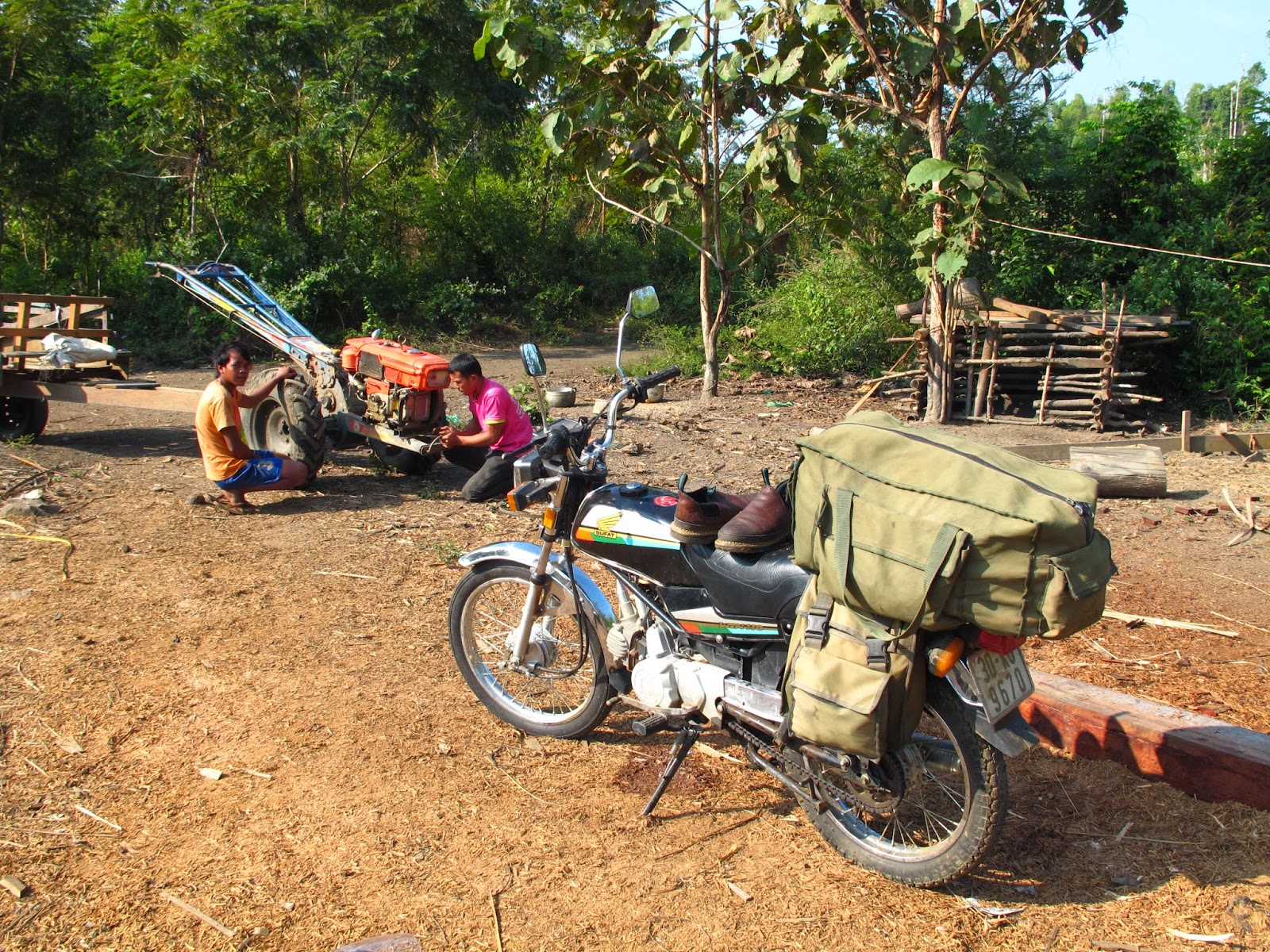
We should discuss tractors. Or “tractor-trucks” or, maybe for brevity I'll suggest “Trucktors”. The basic prime mover is a single cylinder diesel engine from China, the same engine used in most of my smaller Vietnamese fishing boats. They come in different sizes rated in Kilowatts and I don't worry about that. They mostly have a headlight at one end of the engine housing, a fuel tank on top and a water jacket that can boil cheerfully if it wants. Mostly, no radiator. They have a huge cast iron flywheel with a multiple drive pulley bolted to its center. The motor sits in the tractor frame, which, as it arrives from the factory looks like a pair of really long rototiller handles, with a little bit of a gearbox at one end. A minimum of two fat V-belts carry the power from engine to gear box and the output all goes through two axles out the sides of the gearbox. You can put rubber tractor tires on or big steel paddle wheels for working in the rice paddy when it's wet. They'll pull a plow the same size as a water buffalo will, but faster, or a harrow and I've seen a few with monster actual rototillers working behind the paddle wheels. Don't know exactly how the gearing or belting works for that. The ones I've seen have 3 speeds forward and one reverse. The clutch is a simple belt tightener. The wagon is a locally made affair, long wooden A-frame, a couple of chunks of hardwood to carry the axle, the wheels and tires, often old automotive wheels, but sometimes proper wagon wheels that go on and off with a single hub nut. There are no springs anywhere, everything is solid. Besides the long frame members there's always a wooden deck. Sometimes there's a full truck box with seats for six or so per side. Othertimes just a single front wall. The driver sits on a short ledge in front, often with a fertilizer bag full of rice straw for padding. The things are pretty much unstoppable, and will run underwater until their air cleaner goes under. . .if you don't mind the spray from the flywheel and pulleys. There are no guards or fenders. They'll do at least 20, maybe 25 mph on the highway and slower than a walking man up anything they'll stick to. Oh. No brakes. That makes for interesting driving techniques on steep hills. Come to a full stop at the top, put her in first gear and stay out of the throttle. Especially if there's a narrow bridge at the bottom.


Morning brought a new day and the old soup and rice. Actually, a new batch of rice and a batch of some sort of yam-tuber-who knows. Mom and Junior each ate one straight out of the fire but I didn't see them again. Perhaps they were for the stock? Or maybe lunch, which I wasn't around for. The bush telegraph had produced a mechanic to look at the bike, tighten a few things and change the mayonaise. He informed me that a trucktor would be there in four hours, or maybe it was a trucktor would take four hours to take me where I was going, or maybe I got the four hours wrong. In any event, the trucktor turned up an hour later with one young man driving, who promptly loosened up the engine on the frame and changed out the drive belts. The old ones looked pretty sad. That done we had a long discussion, pantomime and sketches and settled on nothing. The young man was a bit grumpy and argued with the mechanic (who had turned up again) briefly. Then we loaded the horse and got rolling. Oh my gosh. That machine plowed through mires dragging its belly and the axle of the trailer. It coated the kid with gray mud (but shortly rinsed him off with clear water when we crossed a ford). We went bushwhacking down trails somebody else had already pioneered, but they hadn't been worrying about an overhanging motorbike's handlebars and mirrors. I was really busy, and saved all of her appendages, but got a few good scratches on head and shoulders. . .some of those bushes are nasty. I did not keep track of how many fords or mires we got through or how many holes we fell into. It was a horrendous ride, but the youngster managed his machine pretty well and we kept on moving. Far too soon though he called it a job done, stopped the rig and proceeded to unlash the bike and raise the price.  H'mm. He, for one, was going no further. The road didn't look too bad and he waved his arm down the road and announced “Champasak!!”. Yeah sure. The horse and I got ready to go, strapped on the luggage and helmet and fired her up. Underway again, thinking we might actually live to fight another day. H'mm. We came to a very long very deep boulder type ford about ten minutes later. Far more than we could ride through, big boulders, nothing you could do with it but roll the bike, two men minimum, preferably three. There were two young men washing bikes on the far side of the ford. I left the horse and waded across. Treacherous footing, strong current, pretty clear water (had to be something good about it). I asked for help. They came. Obviously not thrilled (they'd watched me stumbling across, not impressive), but they came. We pushed her across, lifting her up on to the bigger boulders, keeping her upright when she lurched into deeper holes. It was perhaps 80 or 90 meters long, a football field say, or a little less. A tremendous effort. I offered them a few dollars apiece and they seemed happy enough. The horse and I carried on, through a couple of small mires, over a small ford, and then we came to the best mire to date. No help in sight, no apparent route around, no bushwhacked trail to either side. I picked out a route to try across the middle and put her to it. We got almost halfway across before she suddenly sank another few inches, spun out and gave up. We were well and truly stuck. I didn't need to, she was standing up on her own, but I put down the kickstand and slogged back to firm ground and started walking. Four white knights on a snorting stallion came prancing up the trail, headed toward town. I waved them down and tried to explain my problem.  The language barrier again. . .so I quickly jumped on with them.  We came to the mire. They saw the horse standing there up to her axles. They got back on their trucktor and made to proceed. I asked for help. They looked at each other, and then their driver, clearly the leader of the bunch, nodded his head, took off his flip flops and waded in. One other came with us. The boss climbed in the saddle, I showed him how her clutch worked and started the motor. He gunned it and we two heaved and shoved and she moved ahead. We kept it up for 50 feet or so and then he started to move ahead without us. I ran behind as he got up onto the ridge between ruts I'd been aiming for and kept her moving. I ran along behind in the spray trying to help by holding on and stabilizing the rear end, but I'm not sure how much good I did. He was really agile and skilful and made it to high ground whooping when he slipped and nearly fell (a fall into those ruts would have been really bad). There followed a very brief negotiation. For $12 we two could ride with them as far as they were going, apparently all the way to Champasak, or not, as I liked. No real discussion involved. I paid, they loaded the horse WITH HER LUGGAGE STILL ON, and we went. It was horrendous. There was only a little bushwhacking, a few hundred meters, but horriffic mires the horse and I would never have gotten through and many fords, some of which would have been two-man pushers, not solo performances. In the end we came to a hamlet with a small string of shops, and that was their destination. . .they were picking up the basic components of a tractor. We weren't in Champasak, or even close as it turned out, but they were golden, there were no more mires, one small ford, a great many ugly little two-tread bridges (I shiver) but it was easy going by comparison. The horse stepped out onto asphalt about an hour later. There was a truck wash directly across the highway. She got really clean all over, got her oil changed again (it was still pretty foamy, but not mayonaise) and we rode into Pakse like a muddy, bloody tramp riding a fine horse. Funny, but that's the priority.
Goodbye to Viet Nam, the construction zone in no man's land.  At least SOMEBODY is making it passable!

Mountain Jungle, waterfalls (not very many, it's been dry a while. . .

An absolute solid string of semis and heavy freighters loaded to the max with tropical hardwoods.  Oh dear.  

Just a pretty creek.  It must run hard to scour the rocks like that, but not now.

And then the lowlands.  Miles and miles scalped and planted to stuff you can sell.  Well?  No elephants or tigers here!

Here's a mire we got through early on and I thought I'd best take a photo, wouldn't be such a great example again soon, I said to myself.

We got through that one too. . .

Waiting for a trucktor.  Mom and Dad and Mom's Mom I think. . .company anyway.

But this one was the end. . .not too bad for a little ways, but look on across the "lake". . .oh.
That would be the horse having a look at her trucktor. . .first leg of the recovery, changing belts,.

The nice end of the last ford, we stopped to rinse the tructor off so it wouldn't be embarassing when we got to town.

Safe on dry ground, with only one small ford left ahead.  Not that we knew that, but it turned out to be the case.

Loading pieces of new tractor on the trucktor. . .and so we parted company.

Saturday, December 7, 2013

The Dash Through Cambodia

Written from Pleiku (Viet Nam), early morning, December 8th, 2013.  Weather cool, clear and lovely.  Local folks are freezing.

I've done it again.  After three days in the big city (Phnom Penh in this case), getting there early for the meeting, attending the meeting, and finally getting away, I've skittered through the rest of the country with unseemly haste and have returned to Viet Nam.  Actually, the haste was simply the matter of how long I lingered in each town along the way. . .not long. . .not in how fast we traveled during the day.  Each of the day's runs were short, under 200 km until yesterday, and we either stayed late of a morning to finish looking around, or got into town early enough in the afternoon to have a good chance to take care of business (gasoline, oil, wash jobs, all for the horse, and food, lodging, boats, temples and similar inquiries for me).  So we just didn't linger long anywhere.  The countryside from Phnom Penh north to Kratie is almost entirely flat farm country, no doubt rich beyond words in terms of people it can support per hectare.  Cambodia is a major rice exporter and provides an enormous variety and abundance of produce for domestic consumption.  The people are not skinny!  Well, the young people are generally lean and athletic, spend too much time at volleyball and soccer perhaps, and they dance as well.  But compared to Viet Nam, where chunky people are still not common, in Cambodia, they are doing well.  The people seem to be a bit darker on average than Vietnamese, and have more of a tendency toward wavy hair.  By and large, they're good looking people, and their youngsters (ladies and gentlemen as well as kids) can be downright beautiful.  There are far more Muslims in the population than I'd realized before.  At a guess (based on a thoroughly unscientific count of bare heads versus covered among the women of the countryside) I'd guess that 10% or more are Muslim.  There are small mosques in most villages, and in some small places, everyone seems to be Muslim.  Even a number of men wear the white skull cap (embroidered in white as well) that I think I've seen in photos from Indonesia.  In particular, a great many of the river fishermen are Muslim, and essentially all the long, graceful house-canoes they live in and fish from, are Muslim.  So, a great many of my photos, of boats of course, include a high percentage of them.  The men, other than their white caps (which are not common) usually wear western clothes, or substitute a short sarong for trousers.  The ladies and young women brighten the countryside with gorgeous long skirts, bright blouses and sequined head scarves.  If the notion of the clothing was to reduce the appeal of the ladies. . .it's gone astray.

But the main thrust of this visit (after the meeting in Phnom Penh) was to improve my collection of river boats on the Mekong, and that, in some measure, we managed.  To begin with the down side. . .neither the monastery in Kratie nor the old boat builder in Stung Treng were actually building a boat.  The monastery is deeply involved in building a new "big house" where the monks and novices live than in worrying about yet another long canoe right now.  I did take the time to measure and do detailed photos of the two canoes in their shed, the smaller of which I think is one I saw five years ago, just being finished, and firmly upside down by the road.  It's a pretty thing, which looks like it should seat 16 men and boys. . .and I'm informed it normally races with 24 on board.  Some of the kids are maybe small enough to sit two abreast in small spaces!  The larger, over 100' long and narrow too. . .normally races with 70 on the paddles.  Wow.  The long boat was in the midst of a major rebuild, advanced already to the point of replacing the ribs and sanding down the paint to bare wood and re-sealing the joint between the dugout bottom and the added plank above.  If the authorities in PP ever get around to letting the Water Festival proceed again (they've cancelled the past 3 years for various dubious reasons) then the big boat should be ready.

Besides the two in the shed in Kratie, in a front yard (as in the front yard of a house or shop, not a boat yard) I found two other racing canoes laid up and waiting).  That was on a most fortunate short cut to Kratie, through the village of Chlong.  It cut off 75 km of horrible, broken highway after Kompong Cham and went smoothly on two small paved lanes through pretty countryside and for over 30 km, right along the crest of the levee, so there were frequent sweeping views across the river.  I had (coward that I am) refused that short cut years ago, seeing the smallness of the line that marked the last 30 km along the river on my map, but this year, perhaps daunted by the terrors of the broken highway and dust. . .I asked myself. . .just how much worse could it be??  And it was lovely.  I'm not sure there's a real lesson there, but it's worth bearing in mind.

I think both Kratie and Stung Treng, where I spent nights, would reward several days each of careful sampling of the local cooking, but, after you've chased down the boats and the few remaining old style oxcarts, and perhaps photographed the frescoes on the walls and ceilings of the local pagodas, what do you do between meals?  You can only eat so much. . .h'mm.

Things seen along the road:  Chuck holes big enough to hide a bike in, dust thick enough to eat. . .oh, sorry, didn't mean to go into that again. . .uh, well, lots of rice paddy, most of it either ready to reap or just cut down, mostly by hand, though you will see a few small combines cutting and separating the grain from the straw as they go. At least two different sorts of palm trees.  Two different fleets of derrick rafts fishing with enormous square dip nets!  The derrick is boomed up by a handspike winch on the side deck (one lady can manage it slowly) then the center of the big square net is picked with a separate line, which tends to spill the fish (if any) out on to the foredeck of the raft.  The raft. . .about 20' x 60', with quarters in a small house aft, the whole thing made of bamboo, with the flotation arranged catamaran style. . .two separate bundles of bamboo.  There is a gantry and an A frame. . .and the thing is worked by booming up, winching in the topping lift between the gantry and the raft, the length of the pendants from gantry to A frame staying constant throughout.  Interesting.  Not much fish though.  Many different sorts of canoes and power arrangements on the river.  A number of Khmer style temples and a good few small mosques (one with an impressive gilt dome, but most with just a pair of short square minarets).  From Kratie to Stung Treng the road leads away from the river overland in a long loop, passing through low rolling hills (though the houses are still universally built on stilts, no matter that they are far from the river's reach).  Actually, the space under the house, besides serving as a place to store the canoe during dry season (or the tractor or the car or. . .), is a valuable living space, shady but open to any breeze, and they are usually equipped with hammocks and the low table like bedsteads that people here like to sit on to play cards or eat, as well as sleep.  The dark, finely polished hardwood slabs they're made from are silky smooth to the touch and oddly cool, but I can't sit cross legged very long, and prefer to perch on an edge with one foot on the ground.

Looking at the map and considering the generally awful highway surface, I'd planned to go from Stung Treng to Banlung in a very easy day, and from Banlung to the border and on to Pleiku in another.  However, the road was superb or better and all but empty, just an occasional passing SUV, two or three trucks, and just local motorbikes shuttling around. . .easy  easy traveling.  We did the whole day's intended run in 3 hours and had to figure out what to do with the rest of the day.  So we ate lunch, fueled up and ran for the border and Pleiku in the afternoon.  That turned it into a 285 km day, but with good roads the whole way and very little to stop and linger over.  Upland Cambodia is hilly, but not dramatically so. The Ratanakiri road I'd worried about was a piece of cake, with all the red clay politely waiting off the highway and none at all to wallow through en route.  There was a bit of jungle and some savanna-like open woodland, but much much more land logged off and put into rubber or other plantations, with the trees, countless numbers of them, lined up in columns and files, with the diagonals perfect too. . .uphill and down, out of sight.  No doubt it's making a lot of nice tires, and making somebody (somewhere else) rich. . .but not something to linger over to savor the scenery.  Looking at the terrain, I've no doubt that a hundred years ago, or even fifty, this countryside, covered in woods and jungle,  would have supported deer and elephants and tigers and wild oxen at least.  You see a lot of spectacular antlers hanging on office walls these days, very elk like antlers but somewhat smaller, but the creatures themselves must be very rare now.  

But enough, it's starting to be late in the morning and I've miles to run today one way or another, so I'll add some photos and leave you.
The central courtyard of the National Museum. . .splendid displays of statuary and artifacts.

A naga, guarding a bridge. . .the national snake of Cambodia?  Made his way into history by shading the Buddha with his rather formidable hood while he (Buddha) was meditating.  This one is of sandstone, not concrete, with a number of segments crossing the bridge and. . .er. . .another head on the other end.  H'mm.

If she rolls over she'll be wet (and bruised) that's the Tonle Sap River below, down a steep seawall.  The young people are often really beautiful.  

Random view down any aisle of any street market in Phnom Penh

Or maybe this is it. . .super abundance of fresh food

No, wait. . .this is the right one.  You couldn't begin to sample everything in a month or a year. . .

Fresh noodles drying in the sun.

Dip netting derrick raft.  With auxilliary fleet moored alongside

Racing canoes in Chlong, 30 km downstream from Kratie.

Modest Home, many are much fancier. . .

Not quite finished. . .and not really a McMansion, but very nice.  It'll have a fancy staircase down to the ground, probably concrete stairs and stainless tube handrail. . .but perhaps timber.   The old people just never stop being used to stairs!
Putting  up the hay (rice straw really, but the beasts eat it).  The ox cart, with the old wooden wheels and traditional frame is now very rare. . .Five years ago, much more common. Today the rototiller tractors are ascendant.  Prosperity and petroleum dependence. . .h'mm.

Fetching sand for the concrete for the new "big house".  Nobody's working on the racing canoes today.

The big one is under repair, new frames, new sealing, new tie wires (to hold it together side to side) and presumably, new paint.  The small one is in good shape as she is. . .The big one has a crew of 70 men and boys. . .the smaller one, with seats for 16, sits two abreast a lot. . .and races with 24.

The main sanctuary of the pagoda, with really magnificent "life of Buddha" frescoes on every surface of wall or ceiling.  I leaned the camera against a column to make up for the tripod I don't carry.

A selection of canoes on the bank, Stung Treng

Muslim house canoes/fishing vessels, Stung Treng


Wednesday, December 4, 2013

A day or two in Cambodia

Written from Phnom Penh, Cambodia, December 3, 2013.  Weather clear and fine, cool early, quite hot in the afternoon, but a lovely northerly breeze all day.

Actually, we plan to be in Cambodia a week more or less, but here's how it's gone so far.  When last I left you it was in a rush, just leaving Ha Tien, on the other side of the Cambodian border.  It's only a short ways, six km I think, from downtown Ha Tien to the border at Xa Xia (the Vietnamese side) and Prak Chek (Cambodia), clean easy riding, quite pleasant for a few minutes.  The border crossing, last time I was here, was almost rural, two small office buildings separated by 100 yards of quiet road, a few uniformed gentlepersons, and not much else.  Today it's a wall of dust meeting you like a swarm of flies, from acres (or so it seems) of new construction surrounding the two new casinos (just barely) on the Cambodian side of the line.  The casinos are up and running, judging from the traffic, but the new toll plaza and inspection facilities are just thinking about taking shape amid the dust clouds.  Everyone doomed to work there wears surgical masks and wishes they could come up with something better. . .surface supplied air maybe.  And yet, there was no grumpiness or ill temper. . .just getting on  with the job. . .it's a tourist, stamp his passport and sell him a visa and get it done. . .good attitude.  Nobody so much as glanced at my bike or asked to see her papers, which I'd carefully dug out of the office portion of the pack and had ready to hand.  So within the hour we were through the formalities and off down the new (and complete) four lane freeway from the border headed  inland.  Last trip it was 10 km of indescribable ungraded rough roadbed covered on alternate sides by dumps of additional fill material, leaving a thousand S curves through the obstacle course.  And dust. Dust to fill your shoes.  What a difference five years and a casino makes!

Ah, but then about 10 km in we came to what had been a really pleasant little 2-lane highway, well paved and signposted right on into Kampot.  Now. . .four full lanes of  variously well graded to ungraded to (I swear) cultivated monster bump pot holes. . .and again, with long stretches with randomly uncomfortably placed dump loads of more fill material. . .but the crowning glory. . .was the road grader (Komatsu, not Cat) blading it out into a wonderfully treacherous 4 to 6 inch lift of loose new crushed surfacing material. . .Oh my. Fun riding.   The construction ran right into what I'm sure used to be the main street of Kampot. . .and is now a good imitation of a sandstorm in the desert. . .a Simoon is it?  Dust and grit in everything. . .including the soup and iced coffee.

Whew.  But that was the end of it.  Away from the main street's junction with the construction zone, Kampot was still the same sweet place.  It was a French town in colonial days, with lots of French colonial architecture being well preserved and restored these days.  It seems new zoning prohibits changing much of anything in the Old Market area and requires restoration of what's there. . . I had breakfast across from a young lady from the Planning and Construction Department, who also taught me the words for "Thank You" and "Toilet".  Those and some pantomime now and then will probably get us around the country just fine.  Numbers would be nice, but I have a pen and tablet. . .and most anybody selling anything has a calculator ready to hand, even if there isn't anyone handy who can speak English.  There is, though, much more spoken English here than in Viet Nam, so really, it's a pretty easy place to be.  The currency is easier than Viet Nam too.  They just use the greenback dollar.  There IS a local currency, the Riel, valued pretty much at $4000 Riel to $1USD, so $1000R = 25cents US.  They use dollars for pricing everything but small stuff. . .so you soon end up with a pocket of paper worth small amounts and keep having to dig into your hidden supply of dollars.  The people are entirely friendly and helpful, the men are handsome and the  ladies are pretty. . .and except for a few hills leaving Ha Tien. . .the place is flat.

That's just as well for the country's transport.  Although almost any size of motorbike is legal and can be found here, 99% are 125 or 150 cc machines, only a little bigger than what you see in VN. . .but oh do they work!  There are three main ways to use a motorbike (besides just riding it!).  You can pull a tuk-tuk with it. . .You can pull a farm wagon with it. . .or you can pull a side car with it.  The tuk's are for people and are really a delightful little buggy towed behind a slightly modified 125cc typical motorbike.  They have a light framework roof that extends out over the motorbike, rear view mirrors hanging down from the roof with running lights on the front, and tail lights behind.  The upholstery and cabinetry range from old and tired to new and lovely. . .mostly they're painted bright red with pinstripes and bright advertisements on the back. . .but there are green ones and occasionally a silver polished one. . .chrome or stainless body work.  That's a  tuk. . .can go pretty much anywhere in the city and out on the road. . .with at least seven people on board. . .cruises right along at the typical 45 km speed. . .my goodness.  But that's nothing compared to the farm wagons. . .which are also often brightly painted and pretty and twice as big as a tuk.  The wagons need a slightly more extensive modification  to the tow vehicle. . .it gets hurky new springs in back and a very sturdy hitch arrangement.  Some of them just haul freight, rice (stacked up high in bags) or cement (CEMENT???) not stacked up very high. . .but still, that stuff is heavy!  In that case there's no pretty top.  But you can also put benches full length of the wagon bed and a tidy roof over the whole works and there's no end to what you can put in it. . .and somehow the little 150cc motorcycles they usually use to tow them . . .move them right off down the road.  Nobody has explained to me how they can be stopped. . .but that's where the flat as a pancake landscape comes in.  Anything you stop pushing on just rolls to a stop after a bit.  Up and down.is not a concept the road understands.  The sidecar outfits??  They're just for mobile snack stands. . .sugarcane juice sellers, or ice cream men (with Good Humor style music still!) or bright colored soda pop or sandwiches or noodles.  There may be a fierce fire burning in the brazier on the back of the sidecar, keeping the kettle boiling between customer stops, but it's at least a couple of feet from the gas tank.  

So. . .we spent one night in Kampot, which, even with the border crossing, was a really easy day.  Kampot is a riverside town not far from the sea, its old riverfront is a quiet and pleasant place with the old houses made over into restaurants and guesthouses and a certain amount of sidewalk life.  It's not a long walk from the pretty part to a dusty track that leads among rice paddies and small homes and shops out into small neighborhoods and the countryside.  I managed to find us a few very small neighborhoods to poke down into and some sweet little double ended boats "Cambodian boats" they'd called them on the Vietnamese side of the border) and some smiling people to photograph, a very pleasant afternoon.  We'll skip over the nonfunctional wifi and the very early gate lock up at the guesthouse I'd chosen. . .and it all worked out, even the part about the only key to my room breaking off in the lock at 8:30 at night with a sleepy night watchman to deal with it.  Eventually I noticed the screen in the window, slid it side ways and reached in through the perfectly spaced bars to open the door from the porch. Oh dear.  No one else will think of that I'm sure.

The next day was on into Phnom Penh. . .150 km of manicured wide 2 lane (with 2 paved shoulders) superhighway, completely devoid of traffic for 140 of the 150 km. . .straight, level, unvarying, completely smooth.  I could have set the auto pilot and taken a nap.  Until about 20 km from the PP city center. . .when things picked up enough to need a live driver.  Along the way I stopped occasionally to take pictures of green rice paddy and lollipop palm trees with pretty little farm houses (mostly on tall stilts).  A few attempted ambushes of really loaded tuks or bike-trucks didn't yield any great art, but you can see the general idea in a couple of the photos.

The city is not so large or confusing as Hanoi or Saigon and the street naming system (mostly numbers, ergo, my hotel is on 172 street) should be easy.  Unfortunately, what street signs there are are bi-literal, both Khmer (lovely to look at but. . .) and Roman letters. . .but the Khmer takes up more room and the Roman letters are darned hard to read from any distance.  Picky picky.  It would have helped if I'd brought the right guide book, the one with city maps, not the one with artistic photos.  After all, I can SEE what the place looks like!  Well into city traffic we got pulled over by a crooked cop ("improper turn")  who ended up with $30 of my money and of course no receipt. . .if you want a receipt you go to the central police office tomorrow and pay $40 and maybe get your license back. . .or pay me $30 now.  Haven't heard that line since one day in La Paz, Baja California Sur. This rotten bugger at least gave me good directions toward the hotel district after he had my money.  The one in Mexico just took the money and waved me away.  I'm not unnecessarily fond of Vietnamese police, but I've never had that sort of behavior from them in 50,000 km of riding.

But, letting bygones be. . .the city itself is interesting and very very busy. . .bursting at the seams with motorbikes, tuktuks and big fancy cars, lying alongside (and thus more or less parallel with) the Tonle Sap River, which flows both directions, depending on the state of the Mekong.  When the Mekong is high, Tonle Sap flows uphill and fills up the Tonle Sap Lake, which is a big chunk of central Cambodia.  Now, the Mekong has gone down (wasn't it flooding here a month ago??) and Tonle Sap is flowing out like a bear, draining the middle of Cambodia.  I gather the annual flooding has the same beneficial effect on the farmers as the Nile's floods have, a nice fresh coat of rich silt every year is good for your crops.  You just need a house with long legs and a canoe as well as a motorbike.   What do you do with your cows and pigs though?  H'mm.

I need to get out and about and attend the meeting I came for, so will post a few photos and leave you:
The Cambodian side of the border. . .dust mask not really optional

Cambodian Boats. . .in Cambodia, not Viet Nam for a change.  Quiet little side channel neighborhood

We'd better smile at him, he's obviously crazy, taking photos of the backs of houses. . .the young lady spoke quite clear English. . .and that's not terribly uncommon here.  

Boy with kite.  and bike.  Kampot, Cambodia

Nice but not extraordinary Cambodian countryside house.  Long legs.  Must be a canoe around here somewhere.

Cambodian lumber yard with a new shipment of chain sawn planks.

Oh, all right, one smile. . .knocking small fruits out of a tree (dry, pithy fruit with a big seed, in a pod a little like a bean. . .)

Tuk Tuk waiting for custom. . .the normal state of a tuk tuk.

H'mm. Rather a tackier than usual snack sidecar rig.  I'll have to get you a photo of a pretty one!  For short moves the umbrella is collapsed.  Otherwise. . .leave the thing up, especially going downwind!

Seating arrangement and canopy of a farm wagon set up for hauling the whole world, all at once.

Quite a nice (really pretty ordinary) tuk tuk on the prowl. . .the second most normal occupation for a tuk.  That's not a star wars helmet. . .that's a rear view mirror and running light for the tuk.  One on the other side too, and they all seem to have functioning tail lights.  That wouldn't happen in Viet Nam. . .

Farm wagon with a reasonable load.  You can't see it from here, but there's no foot room. . .the interior floor is taken up with bales, bags and roofing tin.  Note the bicycle on the left rear.

This temple was surreal.  Very large, Wide open and completely deserted.  The grounds not particularly well kept.  Not a soul around. . .at least none to see. 

Inside. . .bare, vast, and the walls and ceiling completely covered with gorgeous new frescoes of the Buddha's life!  Every parable and tale you've heard (and then some) all in Technicolor, and bigger than life size.  Where was everyone?  It felt rather as though someone had bequeathed a large sum of money to build a temple in the hopes that, when complete, it would attract a sangha.  Who knows. . .

Family residence and fishing vessel on Tonle Sap River, downtown, opposite the dense tourist area on the Sisowath Quay.  The people seem vigorous and lively but poor.  Muslims, their women wear the full head scarf and long dresses.  Some of the men wear sarongs on board. . .which looks very comfortable.  The boats have a large flooding live well amidships for keeping fish alive.  About 45' long and 9 or 10' wide.  There are usually 10 to 20 in sight on one side of the river or the other, and I've seen similar boats as far upstream as you can get in Cambodia, at Steung Treng.

A new water lilly for me. . .love the puddle in the middle!  Hurray for surface tension!

The architecture here is very vertical and constantly being added to,