Sunday, March 11, 2012

Viet Nam's Baja California, From Nha Trang to Mui Ne


Glorious green in an oasis

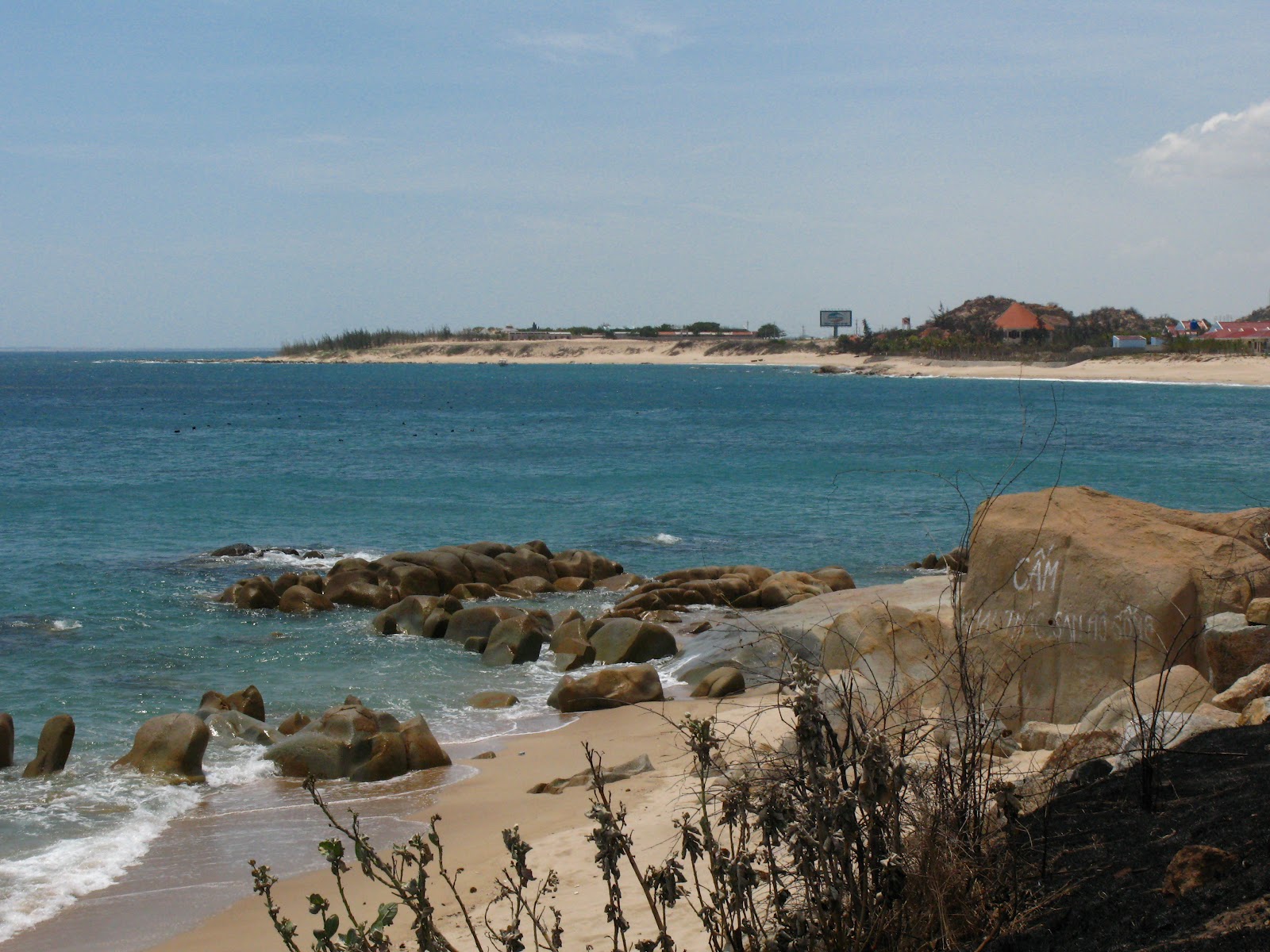
Where the road runs by the sea it's lovely

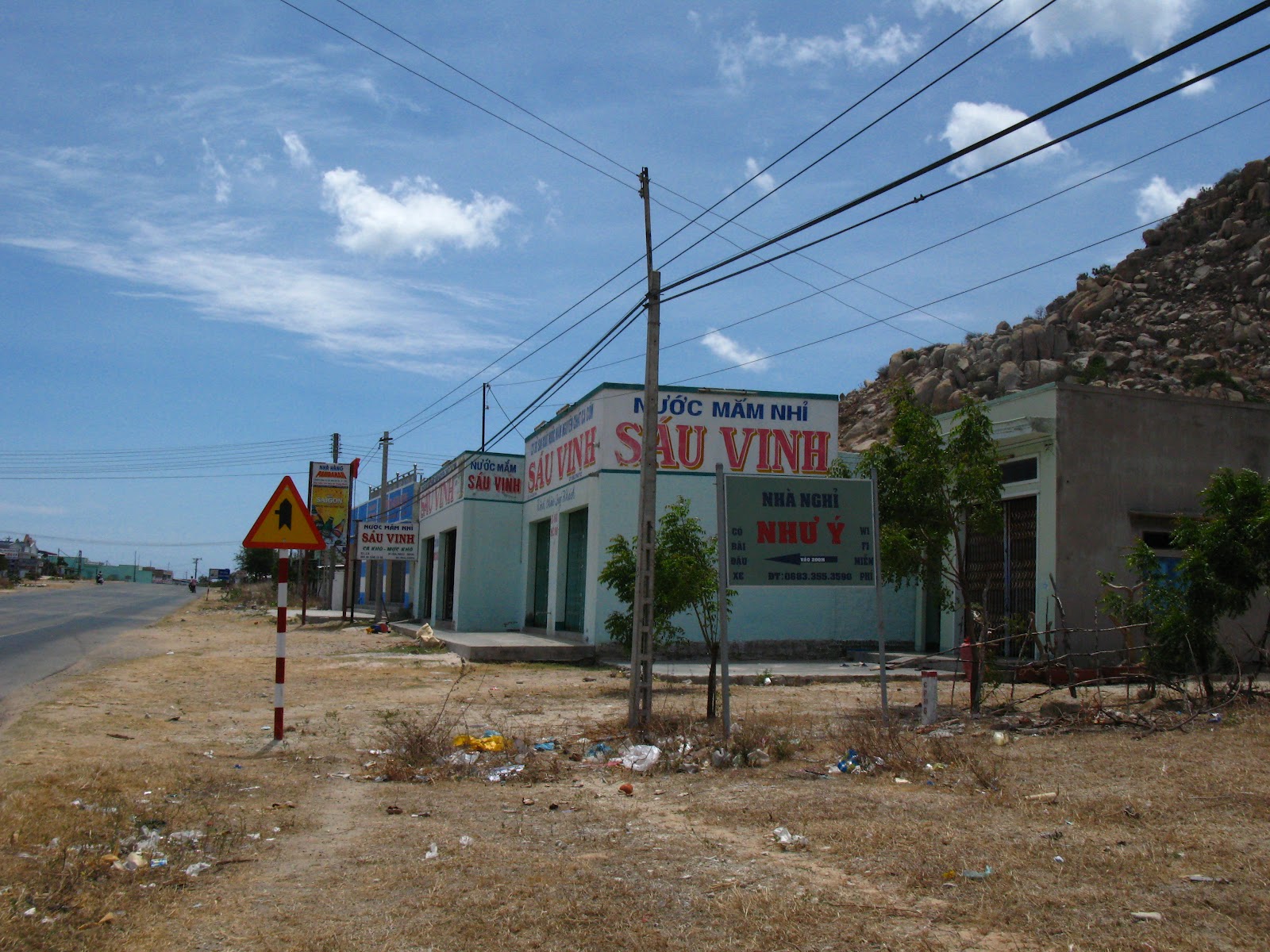
Where not, less so.

Nuoc Mam Factories, sea off to your left out of sight

Nice little house in the desert

A small part of the fleet--Mui Ne

The "new" basket boat in La Gi

The lady leaning on her oars in a nice little pram water taxi.  Like most foot-rowers, she uses a backrest.  No straps on the oars and no suction cups on the feet.  Go figure!

Written from Ba Ria (getting very close to Saigon now) 3-11-2012.  Weather hot, dry, clear and very windy (coming at 30mph or better from the Northeast, and yes, that makes motorbike riding more interesting).

The route to Mui Ne used to run from Nha Trang all the way south to Phan Thiet, where, with a bit of poking around, you could finally find the much smaller road running back north along the beach (or to be more accurate, running along the fronts of the hotels and resorts) 23 km BACK to Mui Ne.  It's easier now.  About 60 km north of Phan Thiet there's a standard Blue and White sign with an arrow off to the left that says "Mui Ne".  If you miss it you can go ahead and ride into Phan Thiet and do the 46 km backtrack just like the old days.  But again, I've gotten ahead of myself.  Long before you have to worry about the turnoff to Mui Ne you leave behind the Viet Nam you've gotten used to, that green lush countryside (with or without some splendid mountains in the background), the endless rice paddy, the dense population, with villages everty little bit, or almost continuously along the road. . .and you come to the desert.  No doubt you could Google it and find out exactly why, but for motorbike touring all you need to know is that the land is bone dry.  Cactus is abundant, if a bit sparse. Sadly, it's not the big sagauros of the Baja, but a plain sort of prickly pear.  There's another cactus sort of thing that's carefully cultivated, trained to grow up a concrete post in the ground in tidy rows and columns.  It starts as a single 'leaf" at the top of the concrete, and eventually becomes quite a bushy Medusa's head of green spiky. . .er. . .leaves I guess.  That and there's scrub brush, though mostly not very much of it.  Population?  H'mm.  not a lot.  As the desert is just warming up, not REALLY dry yet, you pass through what must be a substantial neighborhood of displaced Hmong people, their women wearing long skirts and wrapping their hair in a fabric wrapper, and always, I mean always, carrying a packbasket with something in it.  My impression wherever I've seen them is that Hmong ladies in Viet Nam don't go anywhere without a basket to bring it home in.  Some of the loads look outrageous and the women bend to their work.  Other times there may be nothing more than a machete in the basket (actually, they don't normally go very far without a machete either.  H'mm)  Not that a man won't carry a basket too mind you. . .but not necessarily everywhere. 

After you leave the Hmong neighborhood behind (scratching your head and wondering how mountain jungle people came to be living in a lowland desert) the population drops off rapidly as the rainfall diminishes.  Such people as are living in this zone are mainly either catching fish or turning them into nuoc mam.  At least one town, Ca Na, seems to have no other business, just one nuoc mam factory after another. It's a natural solution, abundant fish in the sea all along the coast, and the heat. . .and with the heat, the ability to get salt out of the seawater.  Nuoc Mam, which is basically the brine from making salted fish and letting it go too long,  is the essential flavoring ingredient in most Vietnamese dishes.  It no doubt got started when somebody opened a barrel of what he thought was going to be some nice preserved fish in brine and found the whole batch had gone bad, the fish was just a purple mush in the bottom of the barrel and the rest of the barrel was nothing but fishy salt water.   Perhaps, having no fish for a while, they found that sprinkling the salty fishy water on rice made it seem like food. . .That's my guess anyway.  It's certainly what it is, a salty, slightly fishy flavored sauce (not all that slight at full strength), normally mixed with rice vinegar or lime juice and garlic, chile, ginger and sugar in various proportions, or ground peanuts and all of the above.  As a nation, the 82 million Vietnamese consume a lot of it.  Those of us living in the diaspora (can an ex GI be regarded as living "in the diaspora"?  H'mm) Anyway, those of us not in Viet Nam also manage to do our share and making, bottling and shipping the stuff is a big business.  Just as well, there wouldn't be much between Nha Trang and Mui Ne otherwise.  A few goats, one or two small oases (lush greenery and flowers are so wonderful in the desert) and the road going through. 

And if that whole stretch of desert sea shore and mountainside is the Vietnamese Baja, then clearly the beach stretching 23 km from Phan Thiet to Mui Ne is Cabo San Lucas. . .or even "Los Cabos".  The high class hotels are shoulder to shoulder nearly the whole distance along the beach side of the road.  The other side of the road is home to restaurants, massage facilities (of various levels of cost and respectability), tee shirt shops, motorbike rentals, surfing instructors, tour guides and their jeeps (Russian as well as American) and SUV's and smaller, much less expensive guest houses.  That's me.  My night in Mui Ne this year cost $8.00 plus 35 cents for a bottle of cold water.  I had a fan that worked, two windows that opened, onto a balcony (one floor above the street), a color TV (don't know if it worked, didn't have time to turn it on), hot and cold running water, two large fluffy towels, and. . .it was all spotless and tidy.  For $200 and up you could get a room across the road and step out directly onto the beach.  Okay.  The restaurants include, by the way, Korean-Vietnamese, Russian-Vietnamese, Vietnamese-dumbed down to European/American, American (pizza??) and real Vietnamese, though those are rare.

Mui Ne town on the othere hand is a purely fishing town.  There's hardly a sign of tourist facilities anywhere in the place.  The restaurants are small and there aren't any menus (heck, some of them just have chairs and a propane burner. . .no restaurant at all).  There IS one superb mechanic.  I save problems for him.  By the time I get down here from Hanoi there's always something.  This year it was the right turn signal had vibrated loose and was hanging by its wires, facing the wrong way.  I'd jury rigged it with some electrical tape, but to get at the mountings you have to take the back half of the bike apart.  He did it in less than an hour and charged me $2. 

The absence of tourist facilities does not, in any way, mean there are no tourists.  The beach access on the main road through town is without doubt one of the most photographed sites in Viet Nam.  Every tour bus stops here.  Every jeep tour, every bicycle riding kid from Japan. . .every body that gets even close to  here stops, gets out of their bus or jeep or SUV, off of their bike (or motorbike in my case) and takes a photo from the top of the cliff.  The more ambitious walk down the stairs to the water's edge.  It's stupendous.  There are over 300 fishing boats in fleets of various sorts and sizes all anchored out in rows and ranks clear across the bay.  The bulk of the boats are finished "bright" natural brown with highlights picked out in yellow mostly. . .but always sparkly bright (at least from a distance), colorful and artistic as heck.  Years ago I got a portrait of the place in early morning light that has been my best to date, but I keep trying.  You can't NOT take a photo.  It's sort of the Grand Canyon of boat-filled bays.

But things they are a changing.  For one thing, somebody invented the fiberglass round basket boat that isn't a basket at all. Worse, they got a heck of a buy on blue gel coat for their new invention.  And worse yet, the fishermen who can't afford a nice new plastic wash tub of a boat. . .have begun painting their pretty old brown baskets YELLOW, or GREEN (ugly, pastel mushy green to be precise) and BLUE, to match the hideous plastic tubs.  It's enough to make a traditional boat archivist leave town.  So I did. 

I didn't mention the board sailers and the kite surfers did I?  They've arrived too.  Sigh.

If you were headed northbound five years ago and you'd looked at the progress of the paving on the new road out of town to the north along the beach you'd have thought it might be worth trying.  That's how I know about the turnoff 43 km away.  You'd never guess otherwise, and that blue sign isn't very big unless you're looking for it.  That first time I rode this way the road wasn't open yet, the asphalt was still warm and I picked up the white stripe painter who was headed back to camp for the night and gave him a lift. . .with his bucket and paintbrush.  He tried to tell me I'd be better off making him walk, but. . .having offered I couldn't back down.  I was scraping white paint stripe off the seat of rhe bike the rest of the trip. But he really had a long ways to walk and it was hot. 

At that time there wasn't anything along the road but sand, goats and scrub brush, all studiously ignoring the stupendous beaches and seascapes that run for 30 km's until the road has to turn west toward the highway to link up.  It's still simply breathtaking, and though the hotels have begun to infest the place, they're going at it reasonably slowly and not making too much of a mess.  It may be fine, and it for sure will offer some better livings than chasing goats through the stickerbushes. 

But I was southbound, so this year I left Mui Ne by the civilized hotel stretch, and, just as I always do Southbound, got lost in Phan Thiet and had to cut through a neighborhood to get back to the highway.  I don't think it's me.  Somebody needs to put up a sign some place!  Once on the road out of town though the navigation is easy all the way to Saigon if that's what you want to do.  However, some helpful person, fearing I might fail to get lost, sent me a photo of a boat on the beach at La Gi.  Google it, there are some nice photos.  More to the point, it's easy to find, (ha) just past Ham Tan (that would be "La Yee" and "Hampton" close enough) on Highway 55, which turns off of Hwy 1 somewhere not particularly clear.  That's the way it shows on my road atlas, which I always believe. What else am I to do??  So, after what seemed like about the right amount of running time for the distance, I started looking at every side road to the left, expecting a Blue and White sign saying "Ham Tan--QL 55"  with an arrow pointing left.  I almost drove by the little sign that just said "La Gi".  Period.  No Ham Tan, no highway number. 

The approach was easy, straight south off the highway for 14 km or so, smooth road, pleasant traffic, a fine thing.  Then we came to a sign that said "La Gi Town".  Still no Ham Tan.  H'mm.  There wasn't any ocean in sight.  No River.  There was a nice temple under construction and later a big Catholic church (kind of ugly modern architecture, not the classic French countryside sort) and then the town sort of petered out and I came to a T intersection.  For which I was not prepared.  In the event, I guessed well, took the branch that had all the signs for resorts (at distances from 3 km to 29 km. . .but where there's a resort, reasoned I, there must be an Ocean.  I did find more town and I did wander enough to find the beach beyond the town and from that beach I could see the masts of a fishing fleet behind a breakwater back the way I'd come, and I did find  a path along the top of the beach that was motorbike-able and thus I came to the wrong side of the boat harbor and found the new sort of basket boat I was looking for.  Most of them aren't really baskets, but that's another story (check the boat website in a week or so).  So I got my photos and hiked up and down the wrong side of the boat harbor a while, astonishing the locals. By this point in time I was parched.  That is to say:  Dried out like a dead fish on the top of the beach.  And there was a blue tarp hanging from some scrubby trees with a wooden bench under it and a lady selling beer and soda sitting on that wooden bench, with that 30 kn breeze blowing the tarp like a sail and that tarp casting lovely blue shade (helped by the minimal leaves on the scrubby trees.  She had ONE bottle of mineral water (if she hadn't had the mineral water, there would have been a dead beer can shortly I can tell you).  So I sat and absorbed that bottle of mineral water and continued to entertain the locals, who definitely had not seen one like me all week.

Then I got on my bike and rode away into the sunset and left my day pack (think diary, road atlas, area map, and insulin) sitting on that wooden bench.  Not on purpose of course, I don't do that sort of thing on purpose, I just do it.  The last time I left that poor pack behind was in a boatyard cafe in Sihanoukville, Cambodia, but that's another story.    (Obviously, that one had a good ending or we wouldn't be leaving the same pack behind on a bench under a blue tarp behind the wrong side of the boat harbor in La Gi this afternoon.)  Well.  I wandered off down the beach and shot some photos of kids playing in the rough surf (30 knot wind, remember) and then I wound and wandered my way back to the road and headed for Ba Ria (where I am now, sitting in air conditioned splendor in the Hotel Galaxy, wondering how I'm going to fit this into my budget).  When I came to a difficult Y in the road (splendid, glorious countryside road I might add), I naturally got out the road atlas to see if it gave me a clue.  And of course, since it was on that bench under that blue tarp. . .I had a hard time opening it.  I was about 60 km down the road then, which wasn't too bad a thing, since it was only 2:30 in the afternoon, so I could still ride in some sort of light for another four hours, and anyway, there had been some perfectly nice looking hotels in La Gi.  So of course I turned around and started tryiing to remember just exactly how I had wandered from the time I started trying to find the wrong side of the boat harbor in La Gi.  I'd seen an awful lot of the neighborhood over an hour or so, most of the streets from both directions.  I could remember two bridges and that ugly church, but not where they were. 

I guess I should point out that when I'm out on the road, everything I have within 10,000 miles is strapped to my bike or my body.  I'm pretty intrepid under those circumstances, poke my way back into the darndest corners.  After all, wherever I get to, by golly there I am.  Now. . .once I check into a hotel and leave my baggage behind I become a very different sort of explorer.  Cautious.  Very cautious.  The idea of being loose in Viet Nam with no luggage, no passport (they keep that when you check into the hotel) and no idea where I am. . .doesn't suit.  But.  I'll cut to the chase.  I couldn't find the danged place.  Worse, I figured out I was following familiar landmarks in a circle.  Which meant I was getting increasingly familiar with the wrong place.  I knew I was within half a mile or so.  .more or less. . .but not WHICH half mile. 

I spotted two motorbike taxis taking a break in front of a coffee shop and pulled up onto the sidewalk with them.  I whipped out my camera and they both ran off.  Dang.  When they turned around to see why in heck I was trying to take a picture of them I managed to get them to come back and take a look at my pictures. . .of the boats about 200 feet from that blue tarp.  They started trying to tell me how to do it and I quickly figured out that wasn't going to work, so I whipped out my wallet and offered them 10,000 vnd (that sounds better than saying 50 cents, but it really is what a short ride costs).  Deal done.  It actually took a little extra effort so I doubled the paycheck when we finally managed it.  Not his fault that he took the job thinking I wanted to go to the RIGHT side of the boat harbor!  When I pointed across the water to where we could see my boats he pointed immediately at the little pram shaped water taxi leaning on her oars (er, that is the lady in the pram was leaning on her oars) I said no, we had to go by motorbike, so off we went and. . .well, there's more to tell, but it's late.  There were fourteen people sitting on and around that bench and a few others in the area and they had every single item out of the bag and passing it around with much hilarity  (what's so funny?  They can't read the diary after all??).  They gave me a rough time about the insulin (I need to learn how to explain that. . .) but, fortunately, I'd been polite earlier and all ended well.  Again.  So I got to ride most of the way from La Gi to Ba Ria twice and all the way once today and that's why I'm here now.


Friday, March 9, 2012

I'd best catch up, we're in Nha Trang Now

Cham Tower near Quy Nhon

The Kids at the ChamTowers

Balancing on the rim of a basket boat

Quy Nhon in the background

Approaching Dai Lanh, Fabulous Island

Inner Harbor and Dai Lanh Town

Lotus flowers really are that color

15 km more or less south of Quy Nhon

The town below the temple

The pagoda's library, through a carved shutter.

Moonrise over Nha Trang Bay
Holy Cow.  I just figured out captions!!!

3-09-2012  Written from the fourth floor sea-view balcony room of the $15/night hotel.. .in Nha Trang, which must be the premier long-time Vietnamese Beach Resort.  Weather is dandy, quite hot at mid day, but cooling now that the sun has set. . .just hot.  A breeze from the bay, music from something down by the beach, a dramatic moon trying to come out from behind a pillar of cumulus cloud--migosh, just a minute, I have to try to get that. . .switched lenses to the new low light f1.8 50mm and set the iso at "really fast" and. . .think we got something useable.  Anyway, yesterday was a fabulous ride through pretty country on excellent roadways. . .followed by today's riding which was even more gorgeous countryside, but some at least on pretty nasty road.  You know, the sort that eats motorbikes and spits out spokes. . .chuckholes you could camp in, complete with lake shore.  However, there was lots of perfectly nice road too, so not to complain.

Yesterday's ride was through a mostly agricultural countryside, endless acres of rice fields, interrupted here and there by a hill or a sand dune. There were people harvesting rice, drying golden green rice on the shoulders of the road, bags of rice moving in every possible conveyance (bicycles to 20 ton trucks, whatever. . .) Todays ride was much the same with the addition of some magnificent sea scapes.   But I'm getting way ahead of myself.

Why do you suppose Cham temples were all built on the tops of the highesr hills around?  The number of loads of bricks that had to be lugged up there before you could even start the first layer is staggering.  The things are nearly solid brick, and they're BIG.  I should probably do some research before I write this sort of thing, but here goes with what I think I know off the top of my head.  The Champa empire was much more Indian than Chinese, and extended across what is now Central Viet Nam from 800 to  1000 years ago.  Their religious practices were almost entirely Indian, and their towers are religious structures, though most of the statuary and religious fixtures have long since been removed to museums. . .or just plain removed.  The towers stand prominently on hill tops, built of fired red bricks, assembled without any mortar, to very close tolerances.  Many of them that had lasted through the centuries were damaged or destroyed in the American war when the Vietnamese took shelter among them (or were thought to have) .  Bricks don't do well with airstrikes and artillery.  Of those that survived, most now have been partially restored to one extent or another.  The modern brickwork is generally very good, and there are many photographs from the early 20th century. . .so the restorations are worthwhile.  As you approach Quy Nhon southbound on Hwy 1 you see one isolated tower on a hill with very poor access (basically you'd have to drive through rice paddy to get to the foot of the hill. . .not good).  Soon after though you see a group of them on a hilltop off to your left.  The turnoff to Quy Nhon is  signposted well, just before a bridge (which you need to cross to get to Quy Nhon).  However, to get to the towers, you need to turn hard left JUST BEFORE the bridge and follow along with the river on your right.  The road is very narrow and well peopled, so go slowly.  Don't drive into the army post (its gate is normally closed anyway) but make the left turn in front of it.  The entrance to the towers is just a ways up the hill, and not too obvious.  It's just a motorbike bridge across a deep ditch, through an open gate and up to a visitor's welcoming sort of structure.  If you've gotten this far you'll spot it.  Pay your 30,000 dong, park your bike and start huffing and puffing up the hill.  It's getting to be quite a bit steeper the last couple of years, but I can still make it to the top.  There's almost always a small welcoming committee, but this year I was there on a national holiday. . .so the kids were out of school and I had a handfull.  All of them were really sweet and friendly and beginning on the "Hello, I Am A Student, What's You Name? Where You From?  My Name (fill in the blank at high volume and ten times at least). 

They walked me up the hill, voluntarily posed in strategic places, Hurrayed at the photos. . .and walked me back down again.  I got them to pose with  the motorbike just before I left. . .midst many "Hen Gap Lai's" and "See You Again's" (a bilingual sort of farewell).

Trying to ride into Quy Nhon I was grabbed by the nose by a whiff of charcoaling meat. . .which turned out to be a somewhat expensive (nearly $4.50) but incredibly good lunch.  The charcoaled meat was served with a plate of greens and sliced veggies and some crunchy fried things to be rolled up in moistened rice paper and dipped in a peppery sauce.  There was a little bowl of really good soup and a bottle of the local mineral water. . .you should have been there, I didn't finish it all!

So I was later into Quy Nhon than I'd  intended.  I talked to a road crew at the end of the new beachfront hotel strip and heard that I'd be at least 3 hours to my intended overnight stop.  It was 3:30.  Dark falls about 6:15.  Quy Nhon is full of good hotels.  I stayed.  Almost didn't.  National Holiday, school's out, kid's are free to go to the beach, h'mm.  But I found a perfectly nice room a couple of blocks off the beach and settled in.  It was my usual routine, checking out the fishing harbor and writing up my diary while sipping mineral water and iced tea and listening to quiet jazz in a shady waterfront coffeeshop.  You really should have been there.

So quickly then, from Quy Nhon to Nha Trang is not a hard day's run, 205 km's with some drop dead gorgeous seascape material en route.  You leave Quy Nhon by the back door, the new (five years old now I think) coast road and you run along cliff tops, winding through the curves, puzzling over five thousand fish farm sorts of buoy arrangements and probably 500 anchored boats tending them. . .you pass villages down impossibly narrow (even for motorbikes) streets that dive off the cliffs into tightly packed houses, shops and schools down just above the water's edge.  Since my last trip past, they've built (or at least finished) a new hilltop temple, with a very imposing concrete and sparkles Quan Am looking out over the red brick roof tops.  I stopped for a better look and met. . .more cute kids.  This gang had a juvenile delinquent, the "big boy" (physically a lot taller and fatter than his friends).  At one point he pushed one of the smaller girls into me from behind and then tried to make out that she'd pushed me herself.  He stood there pointing at her, she stood there on the edge of tears, visibly frightened and saying "sorry, sorry, sorry" while still pointing at him.  I scowled at him and all the rest of the kids bopped him on the head.  Took care of that nicely.  Really, they were all perfectly sweet. . .the delinquent just needs an occasional bopping to keep him honest.

So that's the way it was, a good day, rotten road in places, a good lunch in one of my favorite little towns, Dai Lanh (probably the prettiest place on the Vietnamese coast. . .or if it's number 2 then number one must be stunning). There were nice stops for Red Cow and mineral water, an early arrival in Nha Trang, but again, a little marginally late to keep pushing, so inventory of the river-mouth fishing boat harbor and the passenger boat terminal at the other end of town, another even nicer hotel (the music down the street was a local song and dance troupe, really quite good, with too large a budget for amplifiers, but they've finished and we're down to just light traffic noise. . .and that will be gone shortly.  It's ten o'clock, past my bed time even here.

I'll put some photos with this in the morning.  Good night.


Thursday, March 8, 2012

Trying to Get Out of Hue


Written from Quy Nhon 3/8/2012--Weather wonderful, clear skies, bits of white clouds, stars at night, no haze at all (you can actually see the mountains!!).  But that's here and now, and in order to get here I had to finally bestir myself and get out of Hue.  At least this time it was only my own inertia (and a few explicit tasks to accomplish) that kept me in town.  I finally got it done fairly early in the morning two days back and have spent the past two days pushing pretty hard toward the South. Let me linger in Hue just a few minutes here and then we'll get on the road.

You may remember last trip, while I was basically under night time house arrest in Hue waiting for my passport to get back from a trip to Hanoi for some bureaucratic nonsense having to do with having tried to get into Laos after having given up my Vietnamese visa. . .and being rejected by Laos.  It was sort of a "man without a country"  situation for an hour or two there, then ten (I think I used the word "gruesome" before, and that fits) ten gruesome days hoping my passport would eventually emerge from the mill.  In any event, I was free to come and go during the day but had to be back in my hotel at night. . .not some other hotel. . .only the one I was last legally resident in.  So I wore out the wheels on the motorbike riding any road I could find out of town. . .and still get back by bedtime.  That lead to detailed exploration of "the Island", and that in turn lead to my needing a bottle of mineral water on a hot afternoon and thus stepping into Thanh and Duy's coffee shop and meeting their daughters, the perfectly delightful 2 year old Bao Thi, and the blind and autistic 7 year old Bao Vi.

I'm a fairly hard case and not easily moved, but that young girl, locked in her own head by her blindness somehow got me.  She's profoundly blind, her eyes obscured and usually closed, but that would just be an inconvenience if it were the only problem.  The autism. . .ah yes that makes it a serious problem.  Anyway, I visited several times, and tried bringing  out a`pair of cuddly white stuffed dogs. Bao Thi, at two,  was intimidated by them at first but shortly picked out one and carried it off.  Bao Vi explored one for a bit and then went back to her normal business, tearing up sheets of paper and twisting the bits between her fingers. She doesn't speak or count, but cheerfully finds her way around the house with her hands waving to "spot" obstructions, toes feeling the floor for important changes, goes quickly up stairs and down (and it's a winding staircase), and she dances if someone turns on the stereo in the coffee shop.  She figures out where she is, walks to the middle of the room, and twirls and twists and bows and bends until the music stops. 

Bao Thi is four now and still just a fine kid, nothing wrong at all except she's shy around bearded strangers.  Two is a normal age for onset of the autism and Bao Vi had been apparently normal (except of course for the blindness) until she was nearly two.  She'd even begun talking.  But stopped.  So, without saying anything to anyone, I'd been very fearful for Bao Thi.  No problem.  Bao Vi is nine now, bigger (though still very thin), lively in her odd way and seems to have given up on tearing up all the paper in the world.  Now she loves to find her dad and sit down next to him (and push her little sister out of the way if need be).  Her hair is long enough now to hang down in front of her face and she likes to sit very still and move her head slowly side to side so the fine black hair brushes across her face a few strands at a time.  And motorbike rides!!  She's discovered the joy of flying on a motorbike behind her dad (with Bao Thi sitting on the very tip of the seat in front of him and holding onto the handlebars).  Those are the things she likes. . .but there are many things that frustrate her and bring out a most ghastly scowl  for a moment.  But then it passes and she's on to something else.

In this fouled up miserable beautiful wonderful world, you have to ask Why?  Why do these things (all the tragedies, great and small) why do they happen?  Why can't we make it all right?  Why can't I let go of it?  Don't know.  Don't know.   It's enough to make you cry.

So, to the extent it could, that got taken care of, and Northbound in a few weeks I'll no doubt stop and take them up on their offer of a dinner before I go (Thanh is a splendid cook, so I'd be a fool to miss it).  My good byes got said at the hotel and I met Mr. Can for a last coffee and breakfast together.  It was vegetarian, since it was the middle day of the lunar month (first and middle days are vegetarian for Vietnamese Buddhists, who take a practical approach to such things).  And I got out of Hue.

Actually, getting out of Hue is a very gradual thing.  You're about twenty km out of the center of town and  it still feels a lot like "town".  In fact Hue sort of shades into Phu By, where the old American airbase is now an international airport.  And finally, after a good bit of Phu By you really do get out of town.  My saddle sores seem to have settled down to a dull roar (don't ask me about bandaids on saddle sores if you want to think of me as a dignified sort of person). 

I don't think I've introduced you to The Bike. . .She's a Chinese copy of a 1970's Honda "Win 100", in part even with interchangeable parts.  Her electronic ignition is no doubt a big improvement though.  She seems to manage the load she has to carry and just hums away the kilometers.  Consider that it's quite a load, me and my bags, with  my complete tool kit, rain gear, rubber boots, sun hat, sweater, swimming trunks, computer, three cameras, two guide books (which I haven't used in 2 years but can't leave behind) and the assorted chargers, spare batteries and so forth required to make all the electronics work.  There are enough pills and insulin in the bag to choke a horse and last me the whole six weeks.  I even brought a spare shirt and a a spare pair of jeans,  four spare socks (2 pair) and some underwear.  You wouldn't think she'd carry all that and a toothbrush, but she's quite the little machine.  She weighs at least as much as I do, but not much more, has a 110 cc motor that must produce some horsepower, but not very many, a four speed transmission that's a little harsh, but also a heel and toe type shifter so you can stomp her into gear either direction. . .and it's not really all that bad.  Those four gears have gotten her up to almost 100km/hr on one occasion when I was curious and there was a good opportunity.  That was level ground and no wind, but it took her a while to wind up that tight.  Normally you think of her as a 50 or 60 km/hr sort of person, speeds she can keep up all day long without a whimper.  In fourth gear she'll climb most paved highway grades, but sometimes you have to drop her into third.  If the switchbacks are too steep you might have to find 2nd (and she'll pull any hill she'll stick to in 2nd).  First gear is just for digging out of holes and getting away from stoplights smoothly.   All that and she carries enough gas to last all day. . .and routinely turns in 100 miles per gallon.

So, with the bike running superbly, the weather warm enough to want your sleeves rolled down to prevent terminal sunburn and a marvelously smooth and well maintained road, the past two days have been about as good as this sort of thing gets. 

The country South out of Hue is lovely once you break out into open country. The mountains loom close on your right hand and the sea is never far away to your left.  In places you run along right beside it and in others the mountains squeeze down tight to the water and your route takes you way up the side valleys looking for elevation to get over the high ground.  There are two major climbs, the first just before the beautiful lagoon and beach at Lang Co.  It's posted at 8% grade in places, that is, 8' of climb or fall in every 100' of travel, plenty steep, and about all the bike will pull at speed in high gear.  When you have to slow to make a switchback you'll have to shift down, but no matter, this is a short little climb and well worth the effort for the the view out over the shallow lagoon behind the barrier beach and the town of Lang Co fitted in between.  The surf beats on the outside, but the lagoon inside is all but perfectly smooth, and amazingly shallow for many square miles. 

It was too early to stop for lunch this time, but I pulled into my favorite restaurant there (the one owned by the Khmer lady, whose photograph on the sign hasn't gotten a day older in the time I've been passing by) and had a glass of sparkling water to wash down a can of Red Cow.  While I sipped and stretched and stood instead of sitting, I could see at least six ladies sitting offshore in the shallow water, feeling through the sand for clams.  Lang Co is a wonderful place for clams, oysters, crabs. . .and ocean fish too of course, there is an active fleet fishing outside. 

The hotels along the barrier beach all look pretty posh for a poor motorbike tourist although  I once pulled up in the entrance drive to one of the nicest, and they didn't run me off, (though the gardener looked a good deal more civilized than I) so maybe I'm being too shy.

The other big climb for the day is over Hai Van Pass.  Earlier in the year when I've passed this way it's always been the same, you climb up the north side of the pass in mist or rain and fog, wearing everything you have.  You crest over the summit, wave at the souvenir and snack vendors that were hoping for a tour bus and swoop down into Da Nang, warmth, sunshine, blooming flowers and the South.  In winter and spring it's lilke turning on the lights!  I'm late this year and Spring has already gotten to Hue, but the weather south of the Pass is still markedly "better".  It's full summer here, though not as hot as it will be.  Where the rice is just coming along nicely in fields around Hue, south of the pass there's already lots of rice drying by the roadside and truckloads of rice straw moving around the country.   Flowers are everywhere, the white egrets are out walking their cattle, and most delightful, the sky is clear and the mountains are out.

Normally I'd have stopped in Hoi An for the night, but I pushed on another couple of hours to Quang Ngai, arriving just an hour before dark, which comes very very suddenly in this latitude.  I wasn't looking for a particular place to stay, just that it should be on the south edge of the city for a relatively easy get away in the morning.  When I passed a temple on my left hand with a large white Quan Am in front I took the next hotel I came to, which looked fine anyway.  Quan Am is the female "goddess" of compassion, really, a Boddhisatva, a person dedicated to the welfare of all living beings and not a "god" at all.  She and the Virgin Mary are pretty much in the same business, trying to relieve our fears and take our problems to higher authorities, assuming there are some.  Anyway, I always find the tall white figure comforting and often stop to pay respects. 

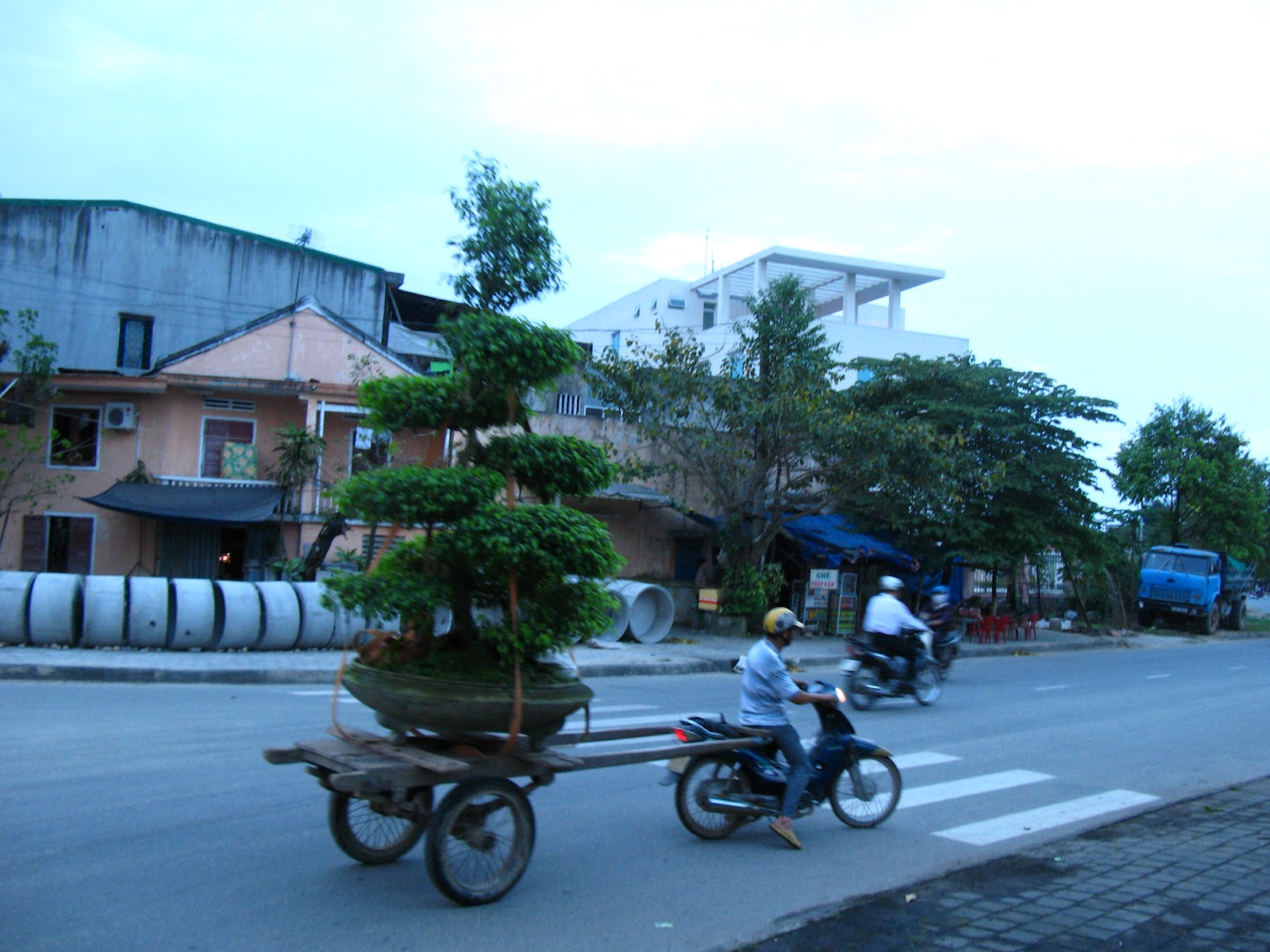
In this case, the temple only houses four old monks and a few lay students and helpers.  It's main function, other than as a house of worship, is training and growing trees in concrete pots and platters.  It's a more practical version of the Japanese bonsai tradition, since these trees and shrubs will actually give shade or flowers or fruit to the rooftops and paved yards of people.  I had just finished tea with the 80 year old monk who found me wandering around the premises when I realized something interesting was happening right in front of the Quan Am.  One of the trees was leaving.

HOW TO MOVE A TREE WITH A MOTORBIKE
Actually, it's quite straightforward.  To make a smooth operation out of it you need two motorbikes, each with its own hand-truck type trailer (wooden frame and motorbike wheels with a steel rod for an axle, they carry huge loads).  The crew of four men arrived on site with a monstrous tripod made of 2" pipe on the back of one trailer.  It's heavy enough to be hard for just the four of them to raise, but they get it done.  Then to walk it into position directly over the tree is straightforward, moving 2 legs at a time.  One leg has a set of "ladder rungs" welded on, and the head rigger slung a chainfalls that had to be 50 pounds over his shoulder, with the chains and block in a canvas bag behind and the gearworks ahead of him.  At the top he hooked the gearworks into a waiting padeye and lowered the chainwheel chain and the load block carefully down amongst the branches.  You can guess the rest. . .they set two straps and evened them up, took a strain on the hoist and easily lifted the half ton of tree and pot off of its base, manhandled the base away and shoved a trailer in under neath.  The concrete pot was a bit too big for the trailer deck, so its feet were set on dunnage.  The pieces of the concrete base were (barely) manhandled on the second trailer, the tripod taken down and blocked up and tied down on top of the bases and the crew was ready for the road.  There was a small matter of the gateway being too low by a foot to clear the tree top, so they had to un-hitch the trailer and tip the tree and trailer WAY forward and sort of persuade the tree top to bend over from a perch on a ladder (which of course was in the way of the trailer's forward motion, but they had that figured out too).   The motorbike pilot needs a runner alongside to help keep the bike and load upright until he's straightened out and going down the street. . .then he's on his own.  Great fun.

I need to be out on the road, this has taken longer than I thought. 

The Photos:  The road stone quarry (business); My home hotel in Hue; The Mouth of the lagoon at Lang Co; A different sort of sand barge; A small street on the island (the bike on the left); Second youngest hotel grand daughter playing with toilet paper (don't say spoiled); Rice Paddy and homes on the edge of Quang Ngai; Rigging and trucking the tree.  I seem to have lost Hai Van Pass somewhere. . .will add it here. . .
Oh, and the young lady who shared my lunch on the road. . .she was very sweet, and careful not to get any finger in with her pork chop. 

Monday, March 5, 2012

The Grand Arrival in Hue and the Aftermath


Written from Hue City on Monday, 3/5/2012
When last we spoke I had just ridden up to the Hotel.  I was expecting a big welcome from Miss Hong the first string desk clerk (and a fine friend, with a shared history of ten gruesome days hoping for my passport to come back from Hanoi. . .but that's an old story from last trip you could dig back through the blog and find).  She had had morning shift, and was off at 2:00.  I came through the door about 5:00.   Oh well.  She'd be coming in tomorrow at 2:00 (shift change) and I'd catch her then.  So, I claimed my favorite room, dumped my bag on the bed and rinsed my hands and face.  I'd managed no more than that, when a great racket erupted down in the lobby. Miss Hong had  dropped back by the hotel and the (new) on duty desk clerk told her I was here so she came screeching up the steps for me and ACTUALLY GAVE ME A HUG. That's an absolute first for me from any Vietnamese ever. Anyway, as it turns out, what she was coming by the hotel for had to do with the fact that Mr. Canh (the hotel owner and paterfamilias of a large extended clan) has been a grampa for 30 days again. . .or maybe that should be has been a grampa again. . .for 30 days. Apparently (and I didn't know about this) Viet Nam is another culture that studiously ignores a new baby until it's managed to make it 30 days, then the whole world is invited to a party to celebrate the new baby. Maybe it has more to do with letting the new mama recuperate a little before she has to have a houseful. . .no, a whole front yard full. . .of company, or more likely yet, it's to give the caterer time to organize the feast.

It's a very family sort of thing, but cousins and employees out to a considerable distance count. Anyway, Hong took me as the big surprise (mind you, I'd just ridden 278 km in 8.5 hours so you can imagine that I was very dusty and no doubt somewhat stinky. There was no getting out of it, so since she was on foot and there were otherwise an uneven number of motorbike seats, I put Hong up behind on my grotty bike with my saddle bags (crusty) still strapped on the back. . .and we were off to the party with a whole fleet of others. (It won't hurt to point out again that the motorbike (or more than one) serves as the family car for essentially all Vietnamese families.  People make all manner of creative adjustments to the size of the seats and 3-person bikes are commonplace, but 2 by 2 is the most popular solution for grown ups). 

I'll not bore you with details of the party.  The baby was small and light brown with a dark head of hair.  All but completely swaddled in soft clothes, there wasn't much showing but a cute round little face as he lay in the middle of a big double bed with female relatives all around.  Mom looked a little tired but very happy.  The street outside for a block or so was filled with motorbikes, the whole house and a large front yard were all filled with tables and the tables were all crowded with people and groaning under their loads of food.  And that was just the first course.  The caterers kept swapping out trays of delicacies, sometimes on alcohol fired stoves to cook things at the table, other times just plain (??) platters of gorgeously presented food. . .stacked high.  A bevy of young helpers circulated with soda pop and beer and no glass was allowed to stay empty, or even close.  I was drug around and introduced at least once to everybody and aside from the Great Grampa I think I was the oldest thing there.  Good grief. The atmosphere was non-stop high volume happiness, everyone talking louder than anyone else, with periodic eruptions of "Mot, Hai Baaaa" ("One, Two, Threeeee") from one of the tables of younger rowdier people enjoying the beer together.  I don't do all that well at parties even when I can understand the conversation.  There was a certain modest amount of  English at my table, so now and then something would get repeated for me, and when Mr. Canh was around he prompted me in Vietnamese (probably on purpose) to show off my vocabulary, so my reputation as  a linguist is probably pretty good today (though I'll never keep it up).    Under the circumstances, having smiled at everyone, shaken hands with most of them twice, stuffed myself on fabulous food. . .having managed all that, I wasn't unhappy when Miss Hong said we had to go early since she had to go to the hospital to visit her father.  That's another story.  I drove her across town to the hotel (using that modern navigation device, the backseat helmet banger. . .as in "bang bang. . .turn right turn right, oh no no no, left, left so sorry. . ." as I faked out the young person trying to pass on what was suddenly the wrong side.) 

One party for one new baby was just fine and I lived through it.  The next morning I was advised to be back to the hotel at 4:00 pm to go to a party for another new baby.  It was the other side of the family, but what the heck.  So we all gathered round, probably half of the same crowd and half from the far side of the family. . .and did it again my second night in town.  This time Hong was on duty so I rode alone and this time, instead of a fairly straightforward route it was twisting and dodging all over Hue (which after all is a big city). There was no hope of my finding my way home alone so. . .Oh well.  I stayed until the last dog was hung, the caterers were gone, and my hosts from the hotel were sitting around with the other grandparents, starting on the left overs (I kid you not) and being entertained by the uncle who'd had the most to drink.  Sigh.  All in good fun though, and we still got home at a reasonable hour, though my ears were ringing and I didn't care if I ate again for a week.

Somehow in the past couple of days I've managed to get out to the island twice for an hour or two, to get over to the big market and buy a HIGH topped pair of rain boots, took a great picture of a little kid or two, and haven't been able to pay for a meal or a drink except for breakfast today. . .I'm being well taken care of.  Tomorrow we (Mr. Canh and I) are going  IN A CAR belonging to the  Stone Quarrying Company, for a tour of four out of five of the quarries.  I think.  These things don't usually work out as I understood the plan.  It's just as well, by the way, that we have the quarry tour to do.  Left to my own devices I'd ride somewhere on the bike and my saddle sores might finally go over the top.  Can you die of saddle sores I wonder???  In any event, there is a certain amount of actual business to take care of here this year, so I'll be in Hue probably 3 more days, one or two for work and one or two (depending) for a long run out on the island.   

Almost two weeks into the trip I can report this has been the easiest so far for my. . .er. . .maybe you don't need to know about that. . .okay, well, I have saddle sores (bruised sit-bones with irritated hide over the top) which should harden up in a bit, they usually do.  My throttle hand knuckles are problematical.  After a full day riding my hand is only sort of functional.  This is something that's been coming on for a while now, but it's the worst manifestation we've seen to date.  I'll have to try to rig a throttle holder on the little bike like the ones on my big bikes at home.  I've looked at it pretty hard and it might be do-able with standard pieces.  I'll bring them next year.

The Photos:  The first party looking in from the street; Cleaning a room in the hotel (3 ladies do laundry and clean 10 hours a day for  11 rooms and the associated stairwells.); A new baby with Mother (the second one actually); Two cute kids at the beach; One cute kid downtown; Flowers in the riverfront gardens; A beautiful young lady on the bridge; A beautiful garden and an old gardener on the island; Four guys clowning around at the beach; A temple and palm trees in the sunset (you'll have to trust me about the temple).
It's late again.


Sunday, March 4, 2012

Two Long Days on the Road, then Parties in Hue

The two long days on the road fit my preferred solution to life.  The parties (yes, more than one) are rather out of character.  Bear with me, I have excuses.  Sort of.  Let's go back for now to a misty, not really raining sort of morning getting out of Sam Son.  I did run out to the shipyard at the river mouth before I got going, which gave the damp air time to think about it.  It decided to keep doing it for a while longer, so I rode through the 10 or 12 km of road repairs back to the highway from the coast in the wet.  Plastered all forward facing surfaces, including visor, exposed pants leg (rain pants and right boot didn't quite meet.  Sigh), eyeglasses (take them off), eyeballs (blink more) and so forth.  However, that was soon over and the road on beyond Thanh Hoa was definitively not under repair.  In fact, it was pretty good, grading into just dandy as the day went on and the weather dried nicely.  Skipping ahead to the last hundred  km or so into Hue on the second day, it was a gloriously good road.  To be so happy!

 Skip back to the first day out of Sam Son. . .To begin with, I skipped the harbor at Cua Lo.  It would have added a day to the ride, and I've already documented the whole place (and fleet) in tedious detail.  So I rode on by even though there seemed to be breaks in the clouds and patches of blue sky out toward the coast when I passed the turnoff.  Perhaps I'll stay there on the trip north and skip Sam Son. . .decisions decisions. 

I simply rode on until I got worried about finding a hotel for the night.  I don't drive at night here if it can possibly be avoided.  No death wish.  So I stopped at Anh Ky, which is. . .er. . .well, not much, but it had a guest house and what I think must have been an old Communist Party hotel.  The guest house was full and the hotel was crowded, but they gave me a room for SEVENTEEN DOLLARS.  That's WAY over my budget.  And it wasn't all that wonderful a room, though the water in the shower was at least warm, the bed was fine. . .and they had 2-bars of wifi that only cut out often enough to make you cuss.  My neighbors sat out in the hallway to get a better signal, but Vietnamese men can squat comfortably for hours and type with the laptop on the floor.  I'd die.  So I stayed in the room, sat in the funny little "easy" chair and typed on the tiny table that held the teapot and TV.  My laptop is quite small. . .just as well.  

I went out hiking and looking for supper (rice porridge with chicken, cilantro, lime, chiles. . .really very good, and chocolate and marshmallow cookies.  What can I say?  They're called "Choco-Pie" and you can buy two in a little cardboard box (or 24 in a big box. . .).  I munched my cookies into the local Yamaha showroom.  Think Toyota or Honda showroom. . .big, white and red building (they're all the same color scheme) two-stories tall, with display windows at both elevations, a big floor display, a rack of gorgeous brochures with all the technical details and very exciting photos.  . .and a good salesman on the floor, even that late in the evening.  He patiently showed me every single model (lots to choose from, and they are lovely machines)!  The prices new range from $900 for a pretty ordinary air cooled 4-speed motorbike to $2200 for the top of the line. . .water cooled, 4 valves, bells, whistles, a 5 speed transmission and the biggest motor available to most people here. . .135 cc's.  They'd sell like hotcakes in the US. . .if only we could get them!

There was a crew of workmen from India living in the hotel, dressed for working in traffic, orange and reflectorized jump suits and hard hats. . .good personal protective equipment. . .perhaps they are electrical line men. . .the Vietnamese don't need help with their roadwork. . .but boy do they need to add electrical distribution capacity!  Fun though, watching that crew in the hotel kitchen in the morning, crowding in among the hotel staff to smush garlic and chiles in a mortar and stir scrambled eggs  and slice tomatoes and mint and so forth. . .they definitely were helping out in a large way.  The final product looked quite good. . .stir fried noodles with the scrambled eggs, tomatoes, garlic, mint, cilantro. . .and who knows what I missed, all served over mounds of white rice and washed down with large glasses of hot tea.  I don't think I did as well, but I wasn't invited to their table.  Perhaps I should have tried harder, they seemed friendly men.  Several were young and handsome and the kitchen maids didn't seem to mind.

So that was day one.  Day two. . .the weather started out gray again but by noon it was SUNNY AND WARM.  I knew I wanted to go south.  The road was splendid all day with hardly a chuck hole or a puddle.  It's glorious springtime here, the rice is well started (around Hanoi it's just barely transplanting time) and the fields are a rich deep green.  Where there's no rice there are fields of vegetables. . .lettuce, cabbages, kohlrabi (is that how you spell that?  i'm sure that's the right name, a green lump of a thing with leaves out the top?  Anyway, it's lovely springtime here and with the weather warming nicely, it is wonderful riding.  The bike, incidentally, is running perfectly, and adds to the pleasure, just humming along eating the miles.  Er.  Kilometers. 

On the road near a small town called Xuan An, which is quite near Vinh which is a good sized city near the mouth of a considerable river, the Hoi, which runs quite a ways inland and apparently is crossed by low bridges I spotted a new genus of river boat.  You ask how I know the bridges?  it's made obvious by the very low houses on the sand barges I spotted unloading.  I first spotted one of the barges just rounding a bend while I was at speed on the bike.  By the time I backtracked, stopped and fetched out the camera it was too late.  Sometimes I'm not quick enough!  However, there was a good second chance a few minutes later.  The barges are quite sweet little vessels, to remind you of the English canals and their pretty little "narrow boats".  The crane doing the unloading was even more interesting though, a locally home-built little thing, it had a big basket of rocks for a counterweight, and hand spliced cables with cable clamps for backstays!  It was run with electric power, so complies nicely with the "Green Ports Initiative", but I'm not sure it's been OSHA certified lately.  Though the bucket is not terribly large, the barges are so tiny that a crew of women lands the bucket each pass to keep from banging up the boat. 

Oh. Sorry, didn't mean to get into so much detail.  But you know, that is the sort of thing I come for. . .or at least some of it.  Still, I wish I'd gotten the one that got away around the bend.

Lunch reaffirmed a lesson or two.  First, the best lunches on the road are usually at the between-towns bus stop places.  Second, always pick a place with one or two busses (indicates a good following among the drivers) but not many more than two (chaos. . .not a good thing when you're a foreigner with minimal language skills).  So I picked one with just a single bus and hit it perfectly. . .everyone had just been served, there was still good hot food left in the kitchen, and the staff had time to show me around.  I pioneered the method 40 odd years ago when I spoke even less of the language and it still works.  Walk into the kitchen and look around you!  But don't overdo the instructions. . .indicate some general preferences, then retire to the table or go wash your hands (ask, it's not always obvious, but it's always there) and await the outcome.  I swear, when I give too detailed an order it doesn't work as well. If the cook is given a little latitude and wants to please. . .you'll be happy.  This was a particularly good lunch, a pile of rice smothered in tofu, tomatoes, sauteed pork (juicy and nice), some nice herbs and salty fish sauce with chiles. . .as well as a bowl of vegetable leaf in chicken broth sort of soup, with a large percentage of the vegetable leaves being fresh mint!  I don't normally appreciate this watery salty stuff with leaves in it, but today's was very very nice.  Mint.  H'mm.  I washed it down with Red Bull.  Full tummy and steady drone of motorbike for another 175 km. . .could be really sleepy in the afternoon.  The Vietnamese name for the stuff by the way is only slightly different. . .Bo Huc. . .Red Cow.  Somehow not quite the same.

The bus had an unusually large number of young families, so there were kids to photograph between bites.  Fun.  Altogether a fine lunch with a pleasant crowd.  When the bus loaded up the driver laid out a square of carpet below the door and put a big laundry basket next to it.  You darned well take off your shoes before you get in his bus!  It was one of the luxury sleeper buses that run long distances day and night. . .the seats (2 deep and 4 across) sort of raise up for sitting and sort of lay back for sleeping.  Not bad, but not on a par with the best class of train I think.  I got away before they did, but they passed me like a quick thought a bit later. . .gone.

The afternoon was wonderful riding through pretty countryside, but. . .how many times can I say that before you get bored.  In the end, I rode down the familiar thickening city streets of Hue, to the sharp turn when you come to the river, along through the park with the ramparts of the citadel on your left and the sand dredges running upriver to discharge among the dragon boats with their tourists.  To the bridge, across and turn left onto Le Loi Street, past another few blocks of riverfront park and then into the hotel district.   Right down Chu Van An Street to the hotel. . .and I'm home in Hue. 

It's late.  I'll explain about the parties when next I write. 

Oh, the photos. . .the Yamaha salesman, misty morning in the countryside, green rice in the countryside, the river barges and the funny little crane, and kids caught me from the other side of the road.  Good night.


Friday, March 2, 2012

A Hard Day on the Road-Hanoi to Sam Son


Written in Sam Son—3-1-2012

Sam Son is about the closest seaside resort to Hanoi, and for me, at least, a great deal more. It's home to a large fleet (or several medium sized fleets, depending on your outlook) of diesel powered woven basket surf boats, or at least boats that still look a lot like baskets. Even more fascinating, it's just about the last home of the Thanh Hoa Province fleet of sailing rafts. I've written about both sorts of boats at some length on the website (and a considerably greater length in “the book”, so if you're really interested, hit the website (www.BoatsAndRice.com) or wait for the book to come out. . .but don't hold your breath!) Anyway, woven boats of one sort or another are by no means rare along the coast, they're simply more durable when bouncing off the bottom in the surf than any sort of wooden boat. They give instead of breaking, and, waterproofed with tar or resin and dung (buffalo by preference), they are easily re-sealed if anything shakes loose in a bad landing, so they've survived competition from modern sorts of boats wherever the men fish through the surf.

Unfortunately, the only local basket boat maker I've spotted has switched to fiberglass. His boats still look right, even from pretty close up. . .but don't be deceived! He has been using an existing basket hulled boat and simply laying up the fiberglass directly on it, so the resulting boat looks just like the outside of a real basket ON ITS INSIDE, and like an out-of-focus basket on its outside. Since a freshly tarred basket looks pretty “out of focus” anyway, it's really an excellent imitation. We'll have to wait a few years to see how they hold up, though maybe the pleasure of a leak free boat for a while will offset the displeasure of a boat that cracks like an egg when finally bounced too hard. Actually, he's fitting the same sorts of wooden interior framing that is traditional in the woven boats and that night add just the needed reinforcement to make surf landings survivable.

And the sailing rafts. . .they go back a long time, reported by the French naval captains exploring this coast several hundred years back. . .and reportedly relatively good sailors (though they thump hard into a head sea). The modern variant is not really a bamboo raft at all and not a pure sailing vessel either. They carry a big Chinese diesel engine running a propeller on a “longtail outboard” sort of arrangement, so the propeller can be hoisted up out of the water when they're landing. They're still rigged to sail, some “schooner” and others “sloop” rigged. . .two masts or one. . .but I haven't spotted any that still mount the traditional dagger boards that let them sail upwind. Now they sail upwind (or in a calm) with the diesel engine and use the sails, if at all, downwind or at most across it. They aren't really bamboo rafts anymore either. All you can see is bamboo I admit, but the bamboo just provides some structural strength and shape to a raft of scraps of white styrofoam trapped between the bamboos!

There's also a major river-front boatyard a mile or so out of town, with some lovely larger boats, both traditional style and the more modern “Motor Fishing Vessel” types, so I've been here before, and almost always under the same circumstances. It's winter or early spring. The sea is often rough and it's cold. The place is set up to house and feed ten thousand tourists and. . .I'm the only one in town. Most of the hotels and restaurants are padlocked. The beach is empty of anything but the working fish boats. There's not a hiker or a swimmer and absolutely not a sun bather anywhere to be seen. The white ponies that are normally painted to look like zebras and saddled with western saddles made of plastic leather to give tourists rides up and down the beach. . .aren't painted at all. . .and they're out wandering the town unsupervised, looking for free grass. One is going to pop soon and she'll have time for maternity leave before the real season starts.

I stopped first in my normal hotel, which has a pleasant roof-top balcony sort of place I'm fond of, but right now the place is not set up to have guests. The gentleman of the house, having given me the long-lost-welcome back (it's been 16 months after all), hurried around trying to make a room habitable, but when, among the dreary, slightly grimy surroundings I flushed the toilet and it flooded all over. . .I gave it up, put my pack back together and said goodbye. He understood, and nobody else in the family had seen me, so it was an easy escape. Loose then, I used my favorite technique for a new town. . .drove down the seaside strip of hotels, past the big ones to another clump of smaller ones, slowed down, and waited for somebody to flag me down. Sure enough, at the Dong Duong (say it “Dong Zoo-ung”) the lady of the household ran out in the street waving vigorously. And sure enough, the place is lovely. It's actually about $5.00 out of my price range for the night ($15.00 and I try to never pay more than $10) but it's nice enough to make it right.

Sadly, I'll probably only be here tonight, though I've been looking forward to Sam Son for months. Last trip through there were a pair of brand new, almost completely finished traditional fishing boats just above the high tide line, probably scheduled to launch within the month. I've been hoping there would be another at an earlier stage of construction I could photograph this time, but alas, nothing on the beach. In fact, it's really close to nothing going on at all. If it weren't for five soccer games, there wouldn't have been any traffic on the main drag at all. . .no, I'm not talking about fans, I'm talking about the games in progress in the street. Mostly they play in the intersections, since it's hard to play soccer on both sides of a median barrier. . .and there's a planter-barrier most of the length of town, so they fill up the intersections pretty completely. The goals are deliberately downsized to account for the smaller playing field, the more formal ones actually made out of rebar and netting and of a size for a 12-year old to carry out into the street and put where he wants it. The informal games make do with a few paving stones laid out in a goal-sort of pattern about five feet across. Either one works fine.

I'm telling you all this because there's so little to tell about the day. The run from Hanoi down here is never a beauty trip, though there are some charming spots along the way. Today (and for a long while now I suspect) they're destroying the highway and everything near it. Actually, that's not quite right. Consider the freeway. I DID manage to figure out the new approach from the old highway in Hanoi to the “new” (now six year old) freeway route southbound. The approach and on ramp structures are finished now and much less obvious than when they were a big construction project. More surprising, the signage is almost completely uninformative, if there is any. However, after two false starts I spotted a Hanoi-Thanh Hoa bus (Thanh Hoa is the province town for the province of Thanh Hoa, which is where Sam Son is. . .) so I stuck to his bumper up the ramp I'd been rejecting on my first two passes and away we went. When in doubt, follow an appropriate bus, if one comes by.

It's about 40 km (I've never measured it, but it's less than an hour I think) of very restricted access freeway (that is. . .one off-ramp in the whole distance, or maybe two) and it's not too heavily used, so it's pleasant easy running through almost entirely agricultural countryside. You just don't want to have any problems. The road was new when I first came this way in 2005, so it's not brand new any more, but still in quite good condition and still has absolutely no development along its banks. If you have a flat you either fix it or walk.

Up to my last visit, the freeway came to an end just north of the town of Phu Ly. simply petered out into desperately crowded and chunked up 4-lane urban road, with a sudden abundance of food, gasoline, tires, all the good things in life.

Today, however, if you're not awake, you blow right by what used to be a no-options exit and continue on onto the “Viet Nam Expressway Corporation” road. Holy cow. The asphalt is still warm I think, absolutely unblemished, brand new signs (including an ominous one every few km's that says “For SOS dial. . ..” For good reason. There is absolutely nothing around. After a mile or two it dawned on me that I'd made some sort of mistake. Or it seemed like it must be. I know the Phu Ly exit very well (an excellent restaurant for one thing, and I never forget those) and it gradually came home to me that this new super road is intended for people REALLY going somewhere. I wanted off. Kept going. Still wanted off. Kept going. Oh my. Finally came to a sign that said “Interchange 2 km” (I know that's what it said because it was by golly bi-lingual!!). I got off. It was less than a kilometer to the old road. The old road was destroyed. Actually, physically, ripped up and piled all over itself. That didn't stop the public from using it, we just had to dodge around the excavators, bulldozers, graders and rollers and try to keep out from under the dump trucks.


The awfulness of the road made good neighbors out of most of us. We stayed in line (no room for passing on the cow trails through the piles of dirt and rock and sewer pipes) and we didn't blow our horns much. But there were a few of us who were really dreadful horses behinds. Those few made a really bad situation almost intolerable. Or fatal, depending on your luck. One dump truck driver, in particular drove with joyous assault, blasting the countryside with the vilest horn I've heard on any road machine ever, blasting it CONTINUOUSLY, while weaving from one lane to the other, shoulder to shoulder, deliberately threatening to sideswipe (and nearly succeeding time and again) everything on the road that was smaller than he (I'm a lot smaller and did not contest the matter at all, but that poor green taxi. . .) At one moment he'd be clear over on one shoulder promising imminent devastation to bicycles and school kids. . .the next on the far shoulder having aced out whomever it was that had been in front of him. I rode within a few hundred feet of him for a long time. . .for all his violence and vile-ness he probably didn't gain five vehicle lengths in five miles, just terrified everyone around him. At times like that I feel so strong an urge to shoot out tires or windshields or brains. . .it can't be good for my karma. There were other drivers trying to make a living delivering the goods up and down the highway and they were working at it hard enough to keep the rest of us really busy, but people like that dump truck driver. . .h'mm. Where's Clint Eastwood when you need him?? Sadly, the Vietnamese police don't really patrol to control that sort of behavior yet, though they've obviously gone into the drunk driver deterrent business. There are a lot of brand new billboards along the highway that are really simple. They show a highway patrolman administering a breathalyzer test to a slightly rumpled young man and the caption says. ..”drink beer or alcohol and drive a vehicle and you'll be sorry”.

I normally get pretty nervous about 40 or 50 kilometers north of the turnoff to Sam Son, afraid I've missed it. The signage in years past wasn't all that great and prompted that sort of nervousness. Today there wasn't any signage at all, since there wasn't any road side at all. They must be widening the road substantially in this present exercise, since not only had they torn up all the existing roadway, they'd even sheared off the fronts of buildings that came a bit too close to the alignment. However, I've been this way often enough over the years that I spotted the turnoff anyway and turned with absolute delight away from the destruction zone I'd been driving on for the past several hours (filthy and exhausting hours to be clear). The road from the highway into Sam Son is a delightful ribbon of pavement 12 km long, just long enough to wind down from the hullabaloo on the highway. Today I ran perhaps 2 km along the way and came to the construction zone. The road is utterly destroyed for the last ten km into town. There are ditches in the middle of the road, excavations for manholes gaping open on the shoulders and into the mddle of the road, stacks of pipe everywhere, piles of gravel, veritable trains of dump trucks, every size of excavator and dozer, a number of graders. . .all to within a half mile of the beach, constant detours and drop-offs and here and there monstrous mudholes. My goodness. I studied the map while I ate supper (in my last clean shirt, jeans and underwear) and I've about concluded the best way back to Hanoi next month might well be by train. That's not out of the question based on today.

The gentleman sitting next to me after supper said he was pretty sure the construction goes on ALL THE WAY TO HUE. That would make it the grimmest two days I've ever ridden through. . .straight ahead.
(Added the next morning. . .I got out on the beach at daylight and the fleet, rafts and basket boats, were all at sea, only a few lay-a-beds left on the sand.  A big gang of people was just finishing a beach-seine set, which didn't yield much (I've seen the same crew bring in most of a truckload, so it isn't always slim pickings).  Then I got out to the shipyard and the deep water fishing port.  A push-ahead type boat was coming up river with all the fish he could haul. . .well loaded, and a big deep water boat was offloading into a truck. . .had it better than half filled already and the ladies keeping tally had whole pages full of figures (they weigh every two or three plastic boxes as they come up, so every fish goes across a postage scale.  The buffalo had delivered a load of gear to another boat, setting up a new net.  The boatyard had two major vessels on the ways, about identical.  One is about half planked, the other not quite framed out yet, so they made good illustrations for 2 stages of the work.  The plank and frame stock was being cut out by a whole gang of men with big Makita sidewinders. . .awkward saws to handle, but powerful, and need to be, ripping thick slabs of hardwood!  The master builder was laying out frames with a single "ships curve" and by eye.